

A Seasonal Guide to Keeping Your Pets Safe: Most spring pet hazards don’t look like hazards. They look like grass, puddles, and flowers. The difference between a close call and an emergency is often just knowing what you’re looking at. Here’s what to look for — starting with a dog named Tofu, who lost an eye to something you may have never heard of.
Meet Tofu
A litter of five husky-mix puppies was found in a bush in Fresno. All of them had foxtails – barbed grass seeds that had burrowed into their fur and skin. When they were transferred to HSSV, four were treated and placed on the adoption floor. The fifth needed surgery. A foxtail had embedded itself beneath his left eyelid, and the damage was already done: a deep corneal ulcer that worsened into glaucoma over the following week. A second foxtail was found in his ear canal. His eye couldn’t be saved.
His name is Tofu. He was about four months old.
That May, Ling and her partner Casey came to HSSV to look at a Rottweiler named Zuri. When they learned she’d already found a home, they walked around to meet the other dogs. Casey spotted the one-eyed husky mix, still recovering from surgery, sitting by himself. When they stepped into his kennel, Tofu walked up to Casey and licked his hand. 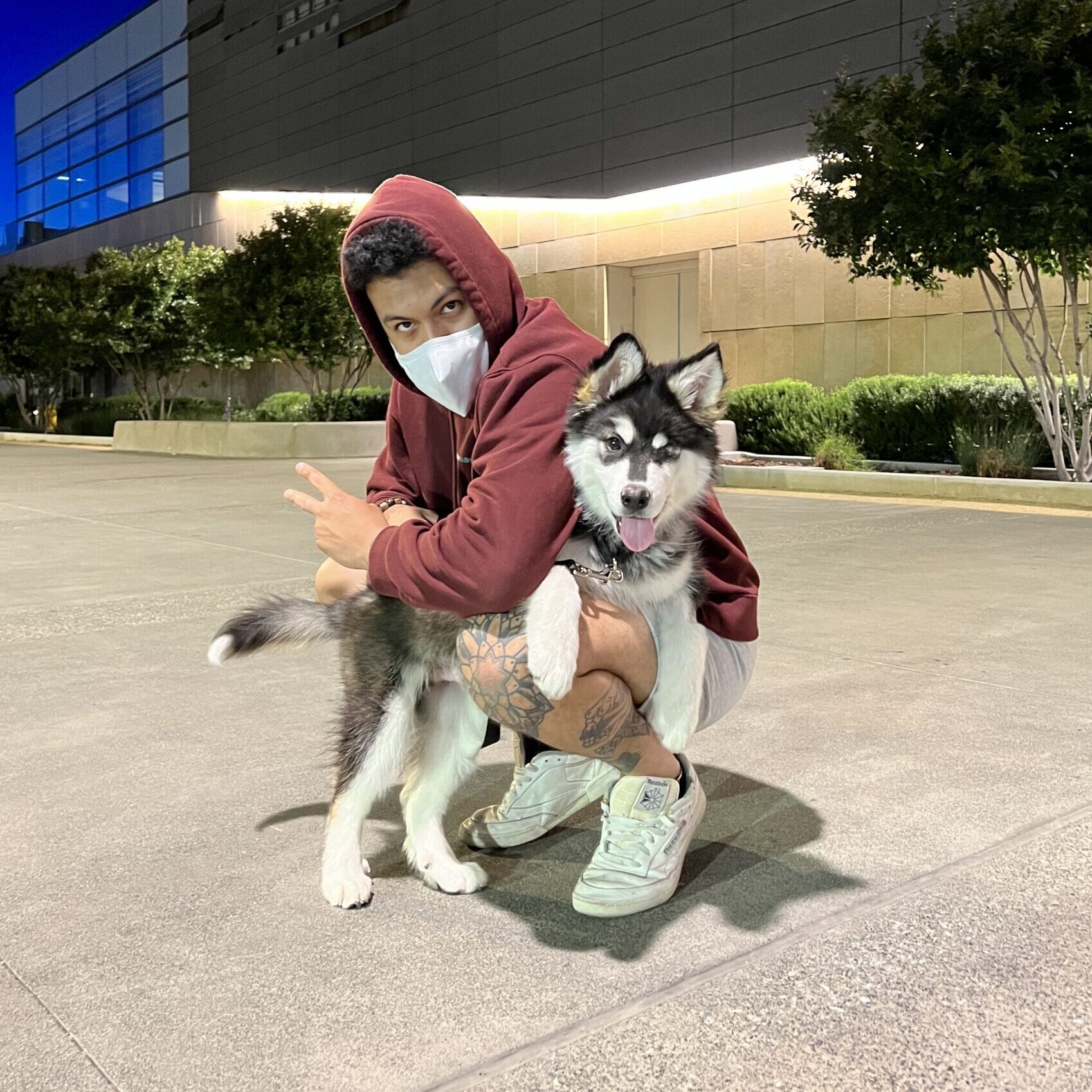
“That’s the one,” Casey said.
The Adoption Associate reassured them that for a dog this young, losing an eye wouldn’t slow him down. This was his normal. The medical team had been thorough – surgery, recovery, everything he needed to go home. “I didn’t have to worry about how I was going to deal with this,” Ling says. “When everything is taken care of, it helps you think ahead.”
Within two days, Tofu was potty trained. Within a month, he was exploring the house. Within a year, he was hiking, dragging Ling to Starbucks for pup cups, and building a bond with Casey so deep that Ling “jokes” about getting jealous.
Tofu is doing great. But the thing that took his eye – a foxtail – is one of the most common and least recognized spring hazards in California.
Most of what’s covered in this guide works the same way: ordinary things, easy to miss, easy to prevent once you know what to look for.
Jump to: Tofu Today • Foxtails • How You Can Help • Other Hazards • Vaccine Protection
View this post on Instagram
Foxtails: The Spring Hazard Hiding in Plain Sight
Foxtails are grass-like weeds that grow across the western United States. California has the most foxtails in the country. In early spring, the plants are green and soft – easy to overlook if you don’t know what you’re looking at. But as they dry through late spring and summer, the seed heads harden into barbed, arrow-shaped awns designed to burrow into the ground.
They burrow into everything else, too.
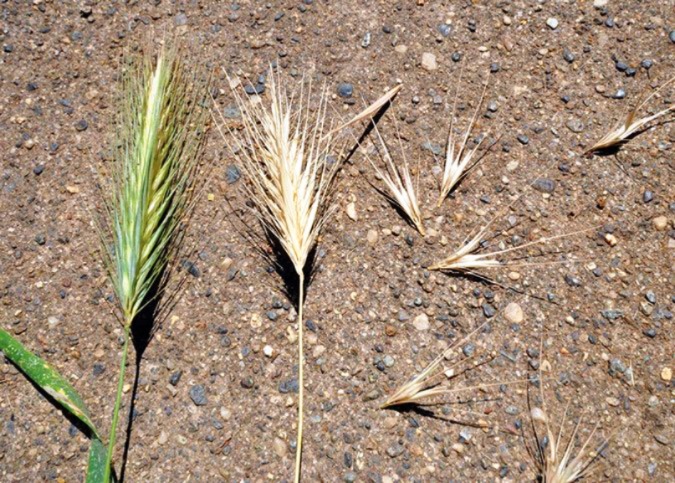
The barbs point in one direction. Once a seed catches in a dog’s fur – between the toes, around the ears, near the nose – it can only move forward. Deeper into skin. Into soft tissue. Into ears, eyes, nasal passages, even lungs. They don’t break down in the body. Removal often requires surgery – in the nose or ears, almost always under full anesthesia.
Signs to watch for
If you notice any of these after spending time outside, especially near tall grass, see your vet:
- Sudden, violent sneezing
- Head shaking or scratching at one ear
- Limping or excessive paw licking
- Swelling between the toes
“I had no idea foxtails were even a thing,” Ling says. Even Californians who grew up around foxtails often don’t know the name or what they can do. “When I see people walking their little dog surrounded by foxtails, I can tell when they don’t know,” she says. “I make sure to let everyone I can know.”
Tofu isn’t an outlier. Last year, HSSV shared the story of Star, a puppy who suffered severe embedded foxtail injuries before finding healing – and a home – through HSSV’s medical team and a devoted foster family. (Read Star’s full story.)
“A foxtail getting stuck in Tofu’s left eye is what resulted in him losing it,” says Casey. “Ever since he was a pup, we’ve been very cautious going on walks and hikes to ensure he stays safe, and my goal was to help him grow confident even though he can only see from one side.”
How to Protect Your Dog from Foxtails
After any walk or hike, check your dog’s coat – especially between the toes, around the ears, under the legs, and near the face. Run your fingers through their fur and feel for anything hard or barbed. If you find a foxtail that hasn’t burrowed in, remove it with tweezers. If it’s embedded, or near the eyes, ears, or nose, get to a vet. The earlier it’s caught, the simpler the removal.
For long-haired dogs, a summer trim reduces the places foxtails hide. On walks, steer clear of dried grass – especially from late spring through fall. A single seed head can break off and blow in the wind. Dogs can inhale fragments just by sniffing along the ground.
Ling and Casey never let Tofu near visible foxtail patches. After hikes, they check him head to tail – and because he’s long-haired, foxtails can hide deep in his coat. “It makes us more aware of our surroundings,” Ling says. “We’re hyperaware when the foxtails come out in summertime.”
Jump to: Meet Tofu • How You Can Help • Other Hazards • Vaccine Protection • Tofu Today
Green Paw Patrol: How HSSV Is Clearing Foxtails Before They Spread
Green Paw Patrol started from a simple need: keep the dog walking paths at HSSV clear of foxtails.
It’s one of several hands-on group experiences offered through HSSV’s Community Engagement program, which brings together corporate teams, community organizations, and individuals for activities that directly support animals – from packing pet food for families in need to improving shelter spaces. Green Paw Patrol is the one that gets people outside.

Volunteers remove foxtails, mushrooms, thistles, and trash from around the shelter’s dog parks and walking areas – hazards that dogs might step on, sniff, or swallow during their daily enrichment walks. Clearing these hazards also keeps HSSV’s campus community cats safe. The work is straightforward: walk the paths, pull the weeds, clear the debris. A group of volunteers can cover the campus in under an hour.
The key is timing. Picking foxtails while they’re still green is far more effective than removing them once they’ve dried out. Dried foxtails are brittle – the barbed seed heads break off and scatter. Green Paw Patrol volunteers learn to pull them early, before they become the problem.
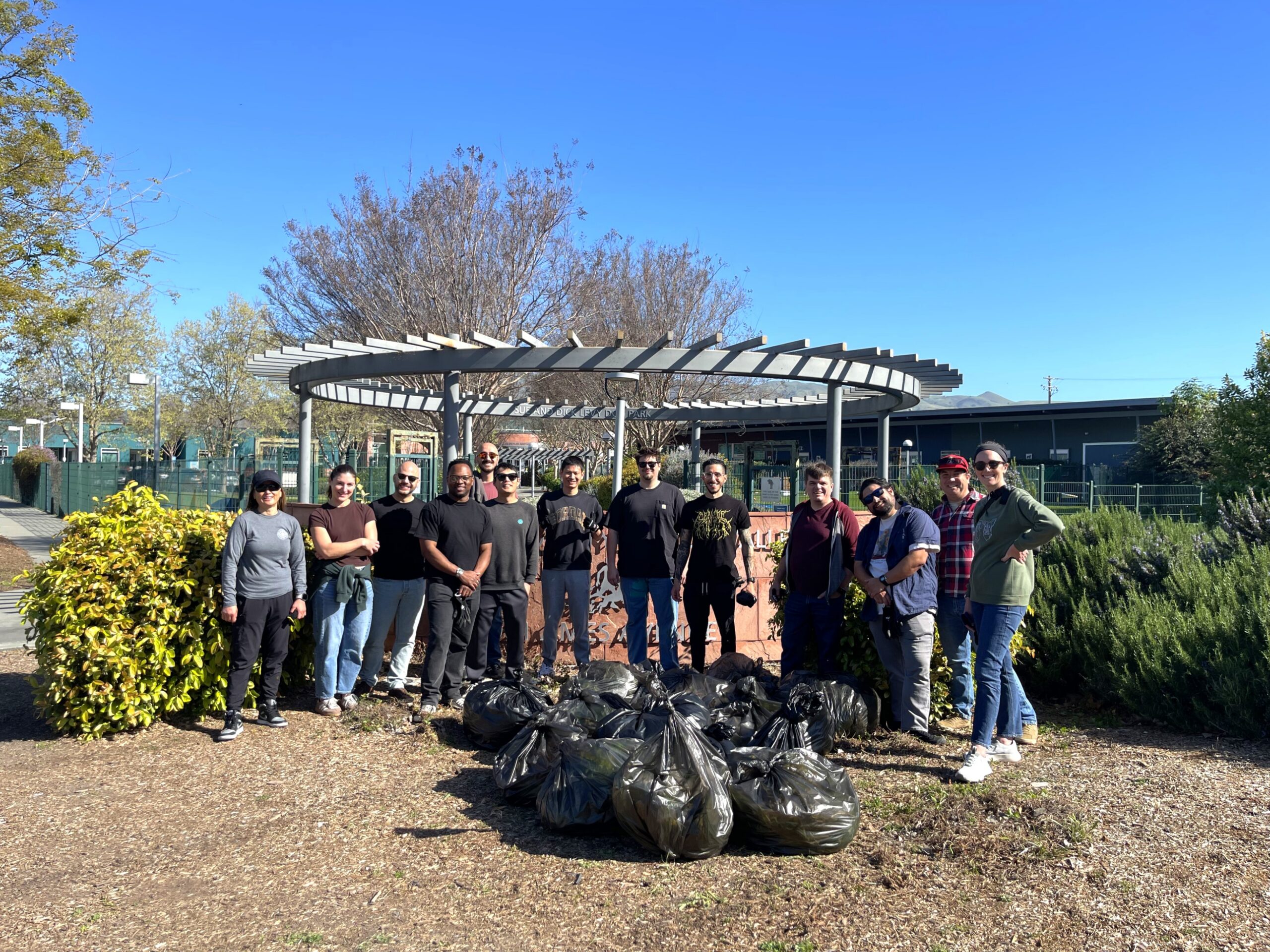
HSSV steps outside the campus as often as possible to clear trails and educate on the topic. In 2025, the program expanded beyond HSSV’s grounds through a partnership with the City of Mountain View and Stevens Creek Trail. Now, HSSV organizes volunteer events to clear hazards from the trail – hazards that affect every dog and dog owner who use it. Earlier this month, HSSV attended Santa Clara County’s Earth Day/Arbor Day Celebration, speaking to roughly 750 students about what foxtails are and why they matter.
For a while, Tofu was part of that education. When volunteer groups came in for Green Paw Patrol, Ling would bring Tofu alongside his sibling Nami. Nami looks just like him – same build, same coat – except she has both eyes. Standing next to each other, the difference is impossible to miss. One seed, one eye. That’s the whole lesson.

“Sometimes it might feel like these groups are just gardening,” says Ling. “After seeing Tofu and Nami and learning Tofu’s story, I can see how determined the volunteers get. I can see them thinking, ‘We’re going to nip this in the bud.’”
Want to organize a Green Paw Patrol session? The program runs Monday through Friday. Learn more about group volunteer experiences →
Jump to: Meet Tofu • Foxtails • Other Hazards • Vaccine Protection • Tofu Today
Other Spring Hazards: Toxic Plants, Standing Water, and Parasites
Foxtails are the most recognizable spring hazard in California, but they share the season with a few others – some of which are already inside your home.
Toxic plants
Lilies are the single most dangerous plant for cats. True lilies – Easter, tiger, Asiatic, stargazer, and daylilies – can cause fatal kidney failure from minuscule exposure. A single petal, pollen licked from fur, water from the vase. In the spring, lilies show up in homes and gardens everywhere. If you have cats, they shouldn’t be in the house at all.
Sago palms, common in California landscaping, are extremely toxic to dogs and cats – the mortality rate can reach 50 percent even with aggressive treatment. Daffodil and tulip bulbs are toxic if dug up and chewed, which is exactly what many dogs do during planting season. Azaleas and rhododendrons can cause serious cardiac and digestive problems.
If you want spring flowers and you have pets: roses, sunflowers, snapdragons, marigolds, and African violets are all safe options.
Standing water
Spring rains create puddles, and puddles can harbor Leptospira bacteria, spread through the urine of raccoons, rodents, and squirrels. Dogs contract leptospirosis by drinking from or walking through contaminated water. It can cause kidney and liver failure – and it’s zoonotic, meaning it can spread to humans. The Bay Area’s spring rains create exactly the conditions where lepto thrives, and it doesn’t only affect dogs who hike. Even suburban puddles carry risk. The good news: leptospirosis is now a core vaccine for dogs, with annual boosters recommended. (More on vaccines below.)
Fleas and ticks
California’s mild climate means parasites never fully disappear, but spring is when populations surge. Year-round preventatives are the standard recommendation. If your pet isn’t currently on one, spring is the time to start – or restart.
Jump to: Meet Tofu • Foxtails • How You Can Help • Vaccine Protection • Tofu Today
Vaccines: What Your Pet Needs This Spring
Spring means more time outside – more exposure to other animals, contaminated water, parasites, and the environments where disease spreads. Keeping your pet’s vaccines current is one of the simplest ways to keep them protected.
If you fall too far behind on a booster, your pet may not just need a catch-up shot – they may need to restart the entire series. Staying current is simpler, cheaper, and more protective than playing catch-up.
Vaccines fall into two categories: core vaccines, which every pet should have regardless of lifestyle, and non-core vaccines, which depend on where your pet lives and what they do.
HSSV’s vaccine clinic is open Wednesdays, Fridays, and Saturdays at the Milpitas campus. Services include low-cost vaccinations, deworming, and microchipping. Schedule an appointment →
For dogs
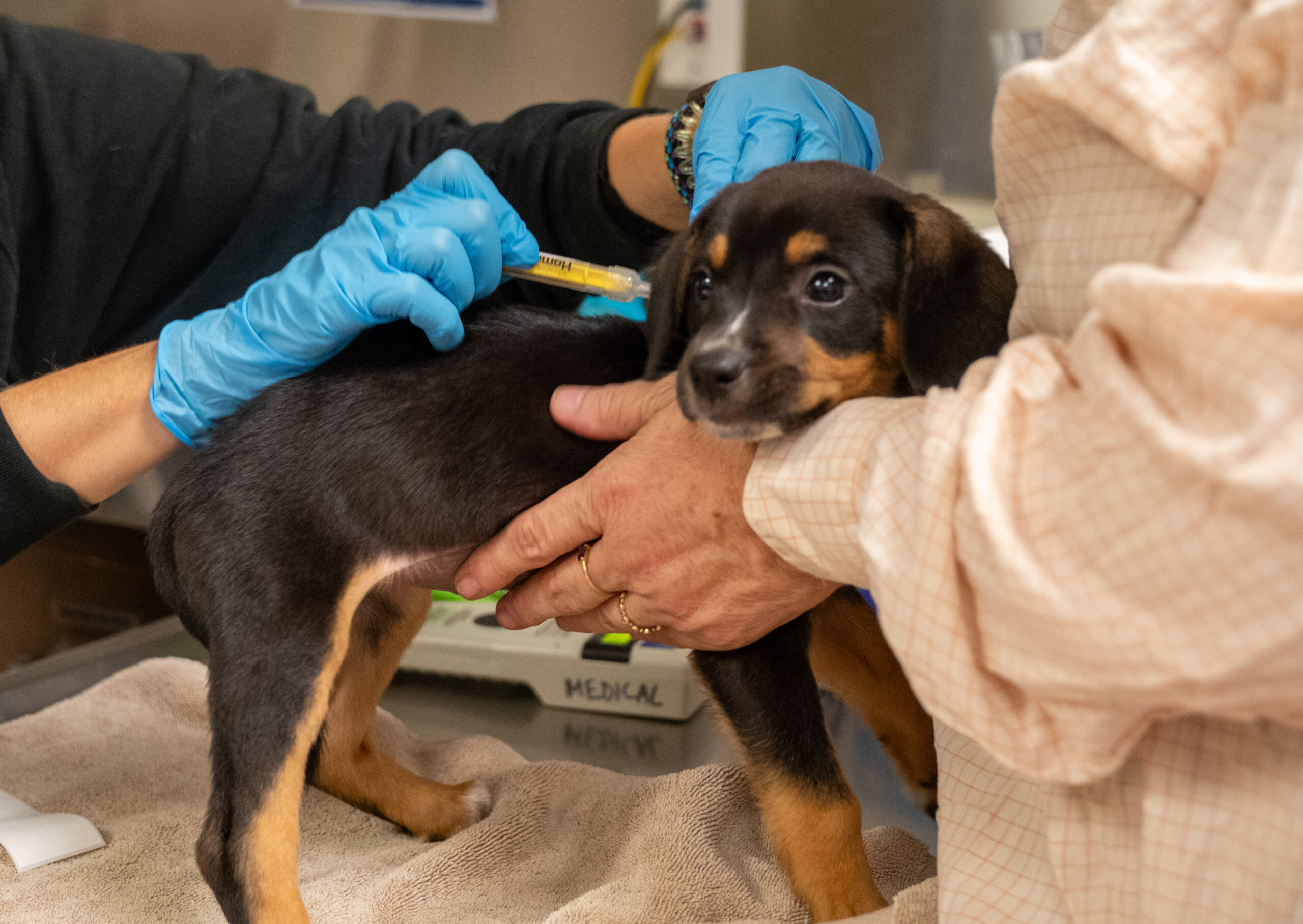
Parvovirus is one of the most common vaccine-preventable conditions HSSV’s clinic team sees – and one of the most misunderstood. Parvo spreads through feces, which means any surface your dog walks on – grass, dirt, sidewalks – can be contaminated. You don’t even have to let your dog outside for it to reach them. Walking through a contaminated area in your shoes and coming home is enough. For unvaccinated puppies, parvo can be fatal. It’s entirely preventable.
Core vaccines include:
- DA2PP – protecting against distemper, adenovirus, parainfluenza, and parvovirus – starts as early as six weeks and is given every three to four weeks until sixteen weeks old. Even then, wait at least a week before visiting a dog park – full protection takes time to build.
- Rabies is legally required and can be given at twelve weeks
- Bordetella (kennel cough) is strongly recommended for any dog who visits dog parks, groomers, or shares communal water bowls.
- Leptospirosis is increasingly treated as core in the Bay Area, where outbreaks have been reported in growing numbers – especially important for pets near rivers or standing water.
Beyond the core vaccines, a few lifestyle vaccines are worth discussing with your vet. These vaccines cost less than the hospitalization they can prevent:
- Lyme disease for hiking families
- Canine influenza for dogs who spend a lot of time around other dogs
- In parts of California with significant wildlife – particularly areas where rattlesnakes are common – a rattlesnake vaccine is worth considering.
For cats
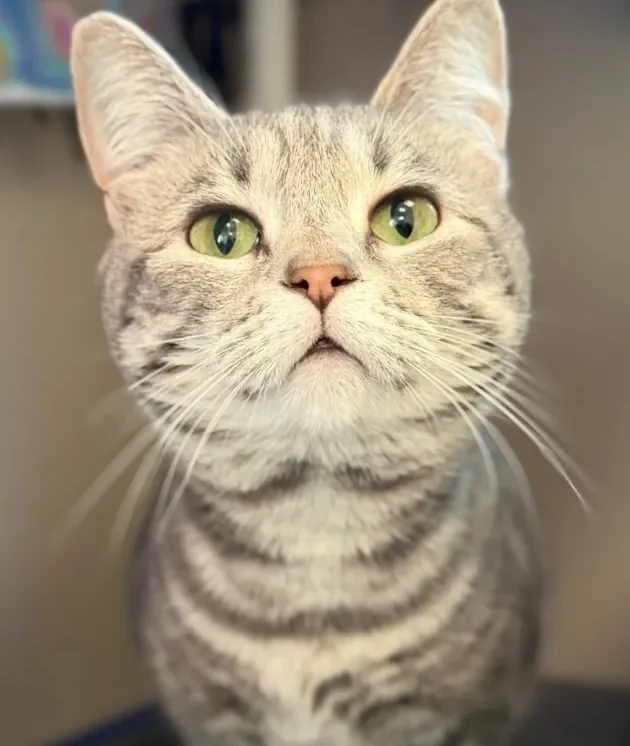
Panleukopenia is highly contagious and often fatal, especially in kittens.
Core vaccines include:
- FVRCP – protecting against feline viral rhinotracheitis (caused by feline herpesvirus), calicivirus, and panleukopenia – starts at six weeks and continues until sixteen weeks.
- Rabies is legally required and can be given at twelve weeks.
- Feline leukemia virus (FeLV) is recommended for all cats – even indoor cats, because escapes happen.
Can my pet handle all these vaccines at once?
Most pets do well with the core vaccines together – DA2PP and rabies are typically given at the same visit without issue. For additional lifestyle vaccines, your vet can space them out over multiple visits. If your pet has had a vaccine reaction before, let your vet know so they can pre-medicate.
Jump to: Meet Tofu • Foxtails • How You Can Help • Other Hazards • Tofu Today
Tofu Today
View this post on Instagram
Tofu is three years old now – a huge ball of pure love who is fully convinced he’s a lap dog. He’s sassy, playful, a little mischievous. The kind of dog who grabs his own leash when he decides it’s time to walk himself, then huffs and puffs extra loud when he doesn’t get his way. He’s also sweet and perceptive. When Ling is upset, he puts his paw on her and looks at her as if to say, it’s okay.
“Tofu has grown to be a compassionate pup who is truly the best blend of an active dog and family dog,” Casey says.
The foxtail that took Tofu’s eye when he was four months old is the same weed that Green Paw Patrol volunteers pull from trails, the same seed Ling now watches for on every hike, the same hazard that most people walk right past without a second thought. Everything in this guide connects that way. The lilies, the puddles, the missed booster – they’re all ordinary until they aren’t. The difference between a close call and an emergency is usually just awareness.
“When kids see that he only has one eye, they always ask,” Ling says. “And it turns out a lot of people don’t even know what foxtails are.”
Now you do. And that’s the best protection you can have.
Jump Back: Meet Tofu • Foxtails • How You Can Help • Other Hazards • Vaccine Protection
