

There are more outdoor cats in Santa Clara County than anyone has counted. Most of them have routines, territories, and people who care for them — people most of their neighbors will never meet. Here’s what TNR is, why it works, and what caring for community cats looks like in practice.
Sophie had been at her new apartment for two days when she saw the kittens.
She was on an evening walk when she saw them peeking out from under a fence in her neighbor’s yard – around six weeks old, old enough to be without their mother, who was somewhere nearby. The next evening, Sophie knocked on her neighbor’s door and asked if she could help.
A few days later, Sophie set a trap. After about an hour, she had Walnut – Sophie’s name for the mother cat – and all the kittens together in one catch. By the end of the week, the kittens were in Sophie’s spare bedroom and Walnut was scheduled for the next TNR clinic. Sophie still hadn’t unpacked.
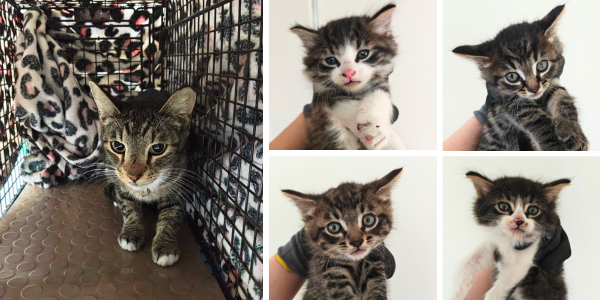
Mama Walnut and her four kittens
This is one version of what TNR – Trap-Neuter-Return – looks like in practice: people paying attention to the cats around them, learning their patterns, talking to their neighbors, and quietly doing the work of preventing the next litter.
Sophie, Humane Society Silicon Valley’s TNR Specialist, has had a lot of these conversations with neighbors. So have the volunteers and partner rescues she works with, and the hundreds of community members across Santa Clara County who feed and watch and care for the cats living outdoors in their neighborhoods.
Most of this work is invisible to people who aren’t part of it. So this is what TNR actually is – what it does, why it works, and how it gets done in a place where there are more community cats than anyone has counted.
Jump to: What are community cats? • Why don’t we just remove the cats? • The eighty-percent rule • How Trap, Neuter, Return works • The people doing the work
What are community cats?
Cats living outdoors get called a lot of things. Strays. Ferals. Alley cats. Most of these terms collapse a wide range of cats into one category, with the assumption that they’re all roughly the same: skittish, unsocial, beyond reach.
Cats, of course, don’t cooperate with narrow definitions.
“Feral is a description of behavior,” Sophie says. “You could have a feral cat that is your pet and lives in your house. Feral is behavior, not circumstance.”
The term most professionals and researchers now use is community cat. It covers the full range of cats living outdoors – friendly or feral, healthy or sick, with a caregiver or without one. The ASPCA specifies that any outdoor, unowned, free-roaming cat falls under the definition.
And within that definition, there is a wide spectrum of socialization that determines how community cats interact with people.
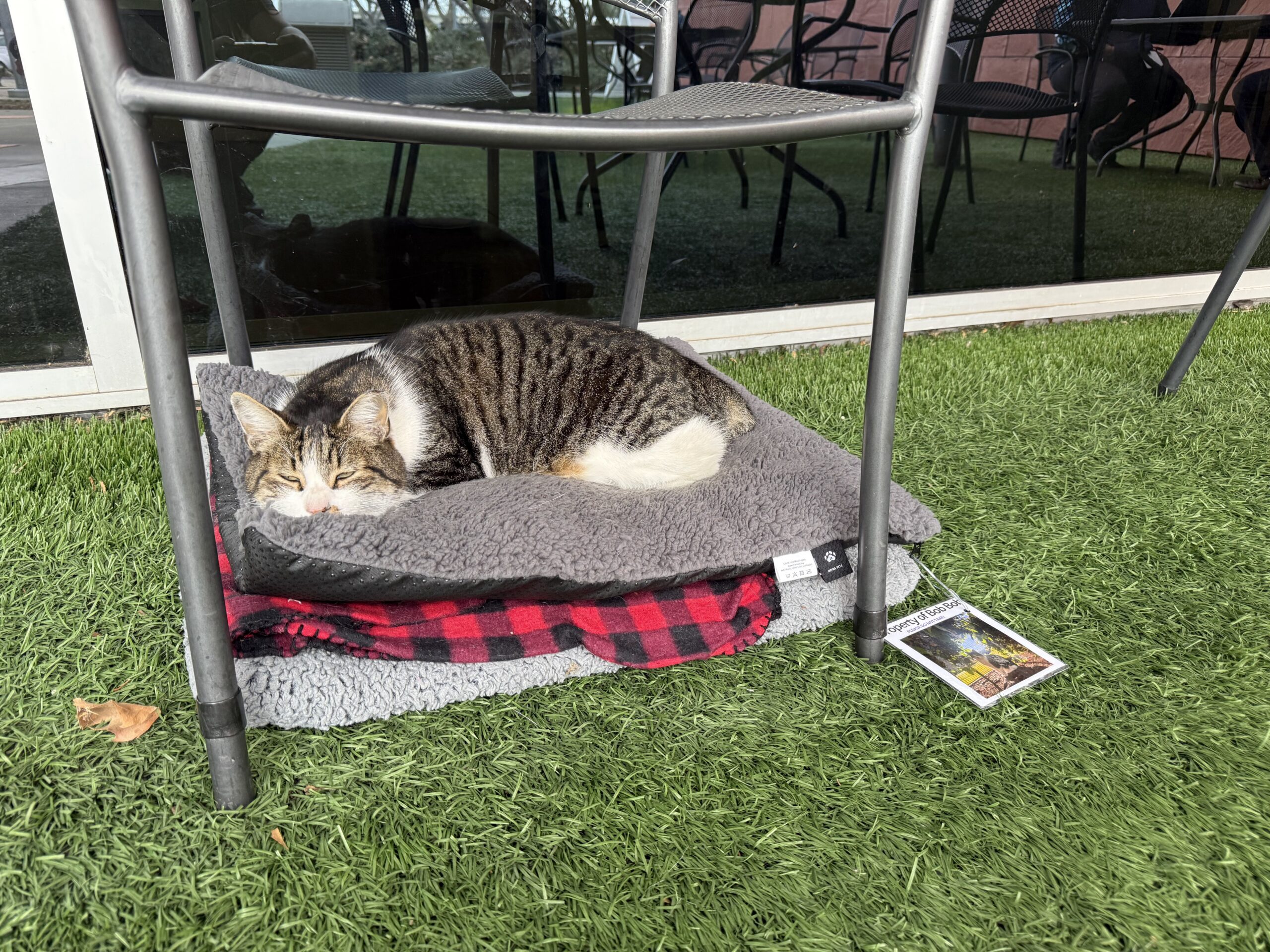
HSSV’s friendly feral, Bob Bob
On one end are cats like Bob Bob, who has lived on HSSV’s Milpitas campus for over a decade and lets visitors pet him near the Adoption Center entrance. On the other are cats who emerge from shadows and won’t come within twenty feet of a person. Between those ends is everyone else. Cats who are friendly to one specific neighbor – probably the person who feeds them – and bolt from anyone they don’t know. Cats who started life indoors, ended up outside, and are slowly working their way back toward people on their own terms. Trust, with these cats, is specific to a person. It builds slowly, sometimes over years.
Where a cat falls on the spectrum has a lot to do with what happened in the first few weeks of their life. Kittens have a critical socialization window – roughly the first eight weeks, sometimes up to twelve – during which positive contact with people typically shapes how they relate to humans for the rest of their lives. A kitten who’s handled gently in those weeks tends to grow up friendly. A kitten who has no human contact in that window grows up wary, often permanently. It’s not that feral cats are different from those we pamper indoors – they’re just cats who never learned, at the right time, that humans are safe.
The language we use to describe these cats matters because it shapes what we do. A cat called “feral” tends to get written off. A cat understood as part of a community – one that lives alongside people, in a particular place, with particular relationships – gets the care they deserve.
Jump to: What are community cats? • Why don’t we just remove the cats? • The eighty-percent rule • How Trap, Neuter, Return works • The people doing the work
Why don’t we just remove the cats?
Historically, the standard response to outdoor cats was to remove them. In practice, that often meant euthanasia – at the time considered the humane option, since community cats aren’t typically adoptable and there was nowhere safe to send them. Some people tried (and still try) to move cats somewhere else, to a barn or a quieter neighborhood, or just far away from the colony. The thinking: fewer cats in a neighborhood means fewer cats, period.
The thinking turned out to be wrong.
Community cats aren’t randomly distributed. They cluster around resources – reliable food (a person putting out bowls, a restaurant dumpster, an area with mice), water, and some kind of shelter. A colony exists wherever those things do, which is why removal doesn’t work.
Animal welfare professionals call this carrying capacity – the number of cats a particular environment can support, set by the resources available. A backyard with one neighbor putting out food can support a few cats. A commercial corridor with a steady food source can support more. The number isn’t determined by the cats; it’s determined by the place. As long as the resources are there, the number of cats the area supports stays roughly the same.
When cats are removed from a territory that still has food, shelter, and the conditions that supported them in the first place, the territory doesn’t stay empty. New cats – usually unaltered – move in from surrounding areas, drawn by the same resources. They breed. Within months, the population is back to where it started. Biologists call this the vacuum effect, and it’s been observed across species and documented globally. Removing cats – only for new ones to show up – is expensive, exhausting for the agencies running the programs, and doesn’t reduce populations over time.
What does work is altering cats, returning them to the neighborhood they came from, and reaching enough of a colony that breeding stops. The fixed cats stay in their territory and defend it from newcomers. They don’t have kittens. The colony stops growing, then begins to shrink as cats live out their lives and aren’t replaced.
The evidence is no longer in dispute. Along a two-mile stretch of the San Francisco Bay Trail in Foster City, a partnership between the city, a local rescue organization, and community members ran a focused TNR program starting in 2004. An initial population of 175 community cats was reduced by 99.4% over sixteen years. Of the 258 cats enrolled in the program, one remained at the end.
Similar studies in Florida, Texas, Australia, and across the United States have found the same pattern: when TNR is targeted and sustained, populations decline. When cats are removed without alteration, they don’t.
The benefits go beyond numbers. Population control has positive effects on the cats it serves and on the neighborhoods they share with people. In Wichita Falls, Texas, an intensive TNR campaign was followed by a 90% drop in cat-related complaints to animal control – fewer than 200 complaints in 2012, down from nearly 2,000 two years earlier. Altered cats yowl less, fight less, spray less, and roam less. The fights and noise that drive neighborhood conflict are mostly mating behaviors, and TNR removes the cause.
There’s another piece of the picture worth highlighting, because it’s easy to look past. Researchers estimate that as many as 75% of kittens born outdoors don’t make it to adulthood – most of them after stretches of illness, hunger, or injury that one can intervene to fix. Preventing those births also means preventing that suffering.
What this means in practice is that the question has stopped being “how do we get rid of outdoor cats” and became “how do we care for them well enough that fewer of them have to be born outside, and the ones already here can live steadier lives.”
Jump to: What are community cats? • Why don’t we just remove the cats? • The eighty-percent rule • How Trap, Neuter, Return works • The people doing the work
The eighty percent rule
For TNR to actually shrink a colony – not just keep pace with new births, but reduce the population over time – researchers have found a clear threshold: at least 80% of the cats need to be altered. Anything less, and the remaining intact cats produce enough kittens to replace what’s been altered.
This finding has shaped how HSSV’s program operates today.
For years, TNR appointments at HSSV worked the way most programs do: anyone in the community could book an appointment online, bring in a cat, and go home with them fixed. It felt accessible, but the results weren’t adding up. 
“Just fixing one cat in a colony is kind for that one cat,” Sophie says. “But it’s not going to do anything to the population.”
So HSSV changed course. Today, TNR appointments are scheduled for colonies, not individual cats. To request appointments, a caretaker needs to know roughly how many cats are in the colony, commit to fixing 80% or more (ideally all), and have a feeder who can see the work through.
Most of those appointments now go to a network of partner rescues like Bay Area Cats, whose volunteers are already in the field, already tracking specific colonies block by block, already on a first-name basis with the neighbors who feed them. Each partner gets a recurring set of appointments and distributes them through their own network of trappers. A smaller share of slots goes directly to community members through HSSV’s request form. A typical TNR clinic can handle upwards of 35 cats in a single day.
The shift in HSSV’s strategy may sound technical, but it amounts to the difference between fixing cats and shrinking populations – between doing the work and finishing it.
Jump to: What are community cats? • Why don’t we just remove the cats? • The eighty-percent rule • How Trap, Neuter, Return works • The people doing the work
How Trap, Neuter, Return works
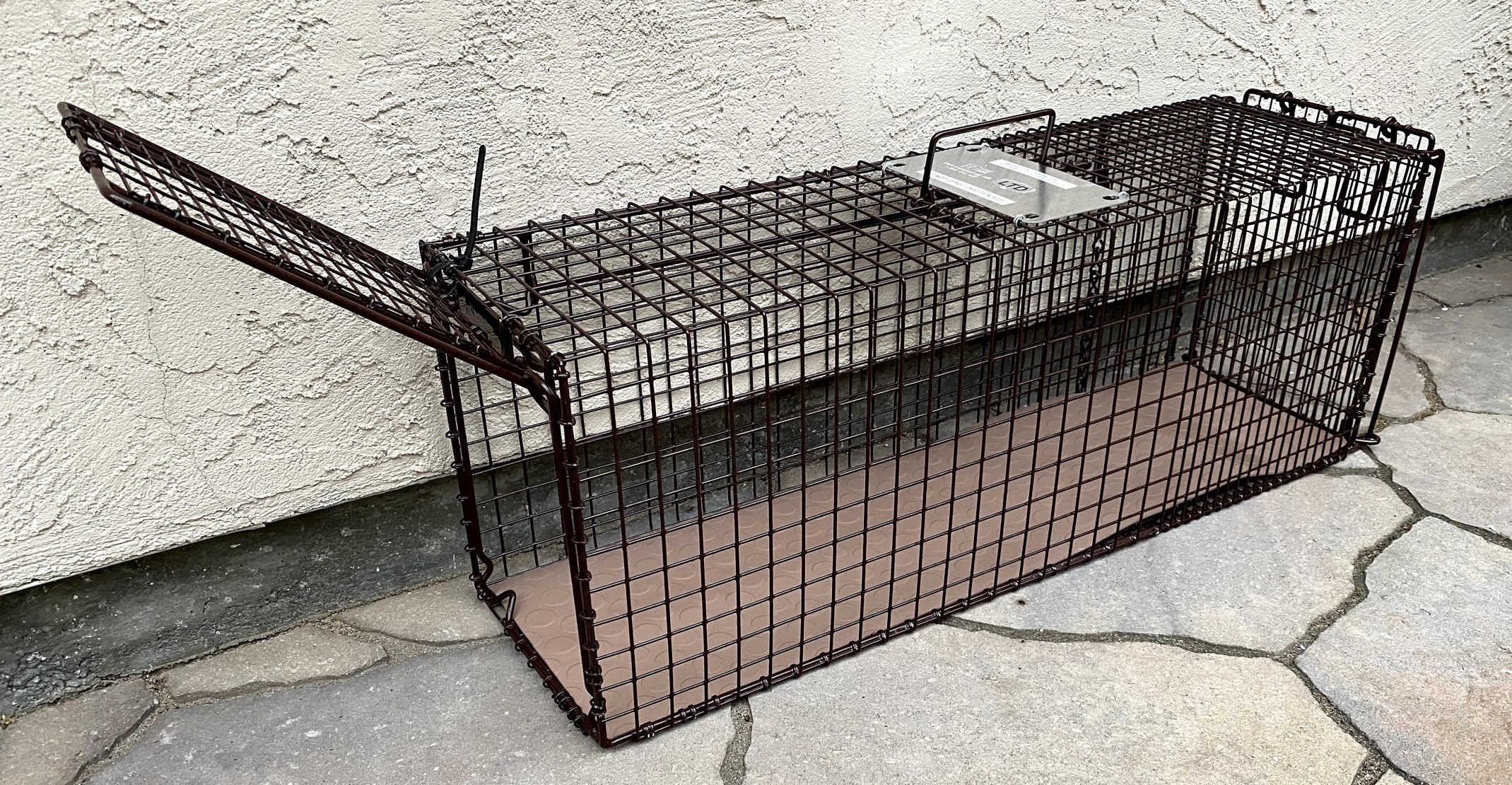
A typical TNR effort starts with one person – usually a volunteer – and a humane trap. They set the trap near where a community cat lives, almost always at night, baited with food that carries a strong odor.
Credit: Bay Area Cats
A trapper – usually a volunteer, almost always working at night – sets a baited humane trap near where a community cat lives. The trap closes when the cat steps inside. The cat is brought to a clinic, spayed or neutered, vaccinated, and given a small straight notch in the top of one ear so future trappers can tell at a glance that they’ve been fixed. Then they’re returned to the exact spot they were trapped, and released.
That last step – the return – is often the part that surprises people the most. The instinct, when you see a cat outside, is often to want to take them somewhere else. Somewhere safer, warmer, more cared-for. But the cats living in a neighborhood already have what they need: a food source, shelter, social bonds, and people who know them.
They’re also deeply bonded to their territory. Outdoor cats know their specific home: which paths are safe, where to find food and water, where to shelter when the weather turns, and which other cats they share the place with. That knowledge is how they survive. Relocating a cat doesn’t move them to a new home; it drops them somewhere unfamiliar, with none of what they know. Many will try to find their way back, sometimes traveling miles and getting hurt or killed in the attempt.
Removing a cat from that doesn’t help them. It just sets the vacuum effect in motion.
Jump to: What are community cats? • Why don’t we just remove the cats? • The eighty-percent rule • How Trap, Neuter, Return works • The people doing the work
The people doing the work
Most animal welfare work is responsive: an animal needs help and someone helps. TNR is the part that runs ahead of the need – work done now so that fewer cats have to be helped later, and so that the cats living in a community can keep living there.
TNR operates on three roles, working together.
The feeders are the foundation – when they’re doing the work intentionally. The most effective feeders aren’t just empathetic towards cats. They know which cats they’re feeding, they notice when a new one appears, and they work with HSSV or a partner rescue to make sure every cat in their care gets fixed. “If you feed them, fix them,” is the message Sophie emphasizes. Feeding without fixing pulls more cats into the area, attracts wildlife, and increases fighting and injury within the colony. Done well, feeding is a structured, attentive form of care.
These feeders tend to know the cats individually in a way no one else does. “The feeders know so much,” Sophie says. “They tell me which cat is another’s mom, which one they had to bring to the vet because of an alarming medical issue. There’s a lot of interesting backstories about the cats and how they’re related.”
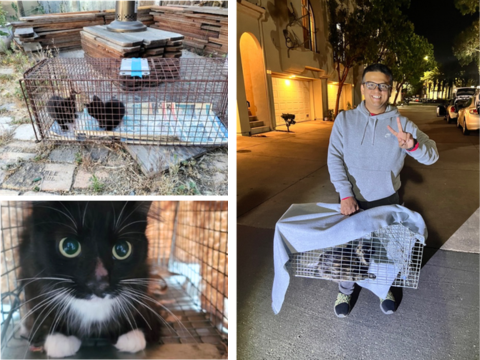
The trappers are the mobile layer. Volunteers, often working with one of the partner rescues, who go out at night with traps, tuna, and patience. Some focus on a particular neighborhood, some respond to colony requests across a county. Their work is unglamorous in a way that’s hard to describe to anyone who hasn’t seen it.
“These people are staying up late, losing sleep, skipping meals, spending money on gas and cat food to trap these cats just to prevent kittens from being born and suffering outside,” Sophie says. “They’re not cuddling them. It’s not like when you foster and can at least enjoy all the fun kitten stuff. It’s the most selfless thing in rescue.”
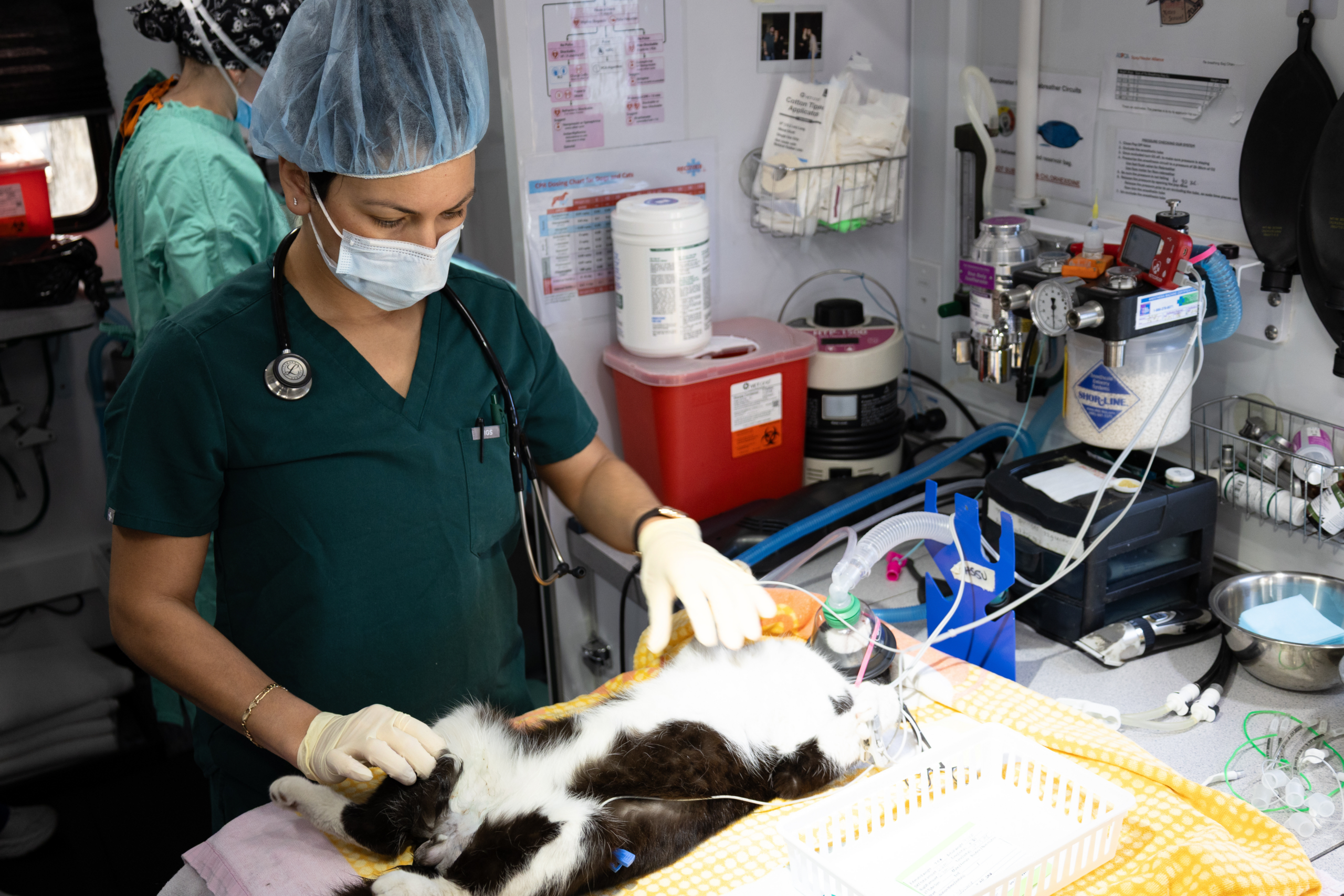
Finally, there’s the veterinary and logistics layer – HSSV’s clinic days, the partner-rescue coordinators, the appointment system that distributes scarce slots across the county. This is the part that turns individual effort into large-scale impact.
 None of these roles work alone. A trapper without a feeder doesn’t know which cats need fixing, or how many. A feeder without access to a clinic can keep cats fed but can’t stop the colony from growing. A clinic without trappers in the field has appointments and no cats.
Most of this is invisible from the outside. A neighbor who has noticed cats in her parking lot for years probably doesn’t know or think about the person who fed them – who got to know them – who set traps, drove them to a clinic, drove them back. The ear tip on a cat’s left ear is the only piece of the work that’s actually visible – and only if you know to look for it.
What this all adds up to is something most people only see in fragments. A larger piece of the picture is a community of cats who are fed, fixed, and known by name on the blocks where they live. The whole picture is what becomes possible when we understand what cats are part of their neighborhoods, the feeders are part of the work, and the work itself is something that has to happen with a community rather than around it.
Jump to: What are community cats? • Why don’t we just remove the cats? • The eighty-percent rule • How Trap, Neuter, Return works • The people doing the work
10 Comments on “Trap-Neuter-Return, explained”
Wow. Thank you for this detailed explanation! I only had a vague idea before reading it how the whole TNR operations work.
Great information so many people need!
One thing I wished had been covered in the article is what is done with the cat between trapping and the spay/neuter appointment. Also might have been good to reinforce not to trap without a spay/neuter appointment.
Great information, as one who will do TNR as it appears necessary in my neighborhood, I hope you run this article a few more times every month at least.
There is a cat colony behind the senior Apt I care for an elderly lady and one of the cats is pregnant!Is ther anyone that is willing to help
With this situation?
Hi Yvonne, Thank you for looking out for these cats. A pregnant cat in a colony is exactly the kind of situation TNR is meant to get ahead of. The best place to start is our Community Cat Program page, where you can learn how the program works and find some resources. Thank you for paying attention to the cats around you!
Community Cat Program page: https://www.hssv.org/services/community-cat-spay-neuter-program/
My mom needs this there’s two cats mom and daughter who had kittens again this year.
Months ago a very yung kitten appeared on my patio, it looked to be only about 6 weeks old and it was definitely feral, it would not come near me but it would eat the food I put out. Months went by the kitty got bigger and fatter, soon it came apparent that she was pregnant and she only looked about 7 months old.
At first when I thought she was a boy I named her loki but when I found out it was a girt I changed it to Chloe. So I borrowed a trap from San Jose animal care center, trapped her, they took out the babies, sprayed her, and I brought her back and see her free. She hangs out with my other cats when they go outside, and I hope someday to pet her.
Months ago a very yung kitten appeared on my patio, it looked to be only about 6 weeks old and it was definitely feral, it would not come near me but it would eat the food I put out. Months went by the kitty got bigger and fatter, soon it came apparent that she was pregnant and she only looked about 7 months old.
At first when I thought she was a boy I named her loki but when I found out it was a girt I changed it to Chloe. So I borrowed a trap from San Jose animal care center, trapped her, they took out the babies, sprayed her, and I brought her back and see her free. She hangs out with my other cats when they go outside, and I hope someday to pet her.
The TN part of TNR is essential, but not necessarily the R. I have managed a community for over 15 years with 50+ trapped and spayed/neutered. Of these 23 were adopted out successfully and now live inside. The urban environment is very dangerous for community cats. I lost over 20 mostly to traffic, also pitbulls, coyotes, accidental or deliberate poisoning, several vanished fate unknown. Yes if one is adopted that tends to make room for a newcomer, another one to trap. But I will always try to find a home for a cat unless it is obviously unsuitable, and most cats are perfectly happy inside given time to adapt. Patience is key. Average lifespan for my community cats outside has been 6-7. One lasted just 3 months. The adopted ones are mostly still alive, many 12+, one passed at 17. Two passed with cancer but it was at least possible to prevent suffering. Also, I’m surprised at the 80% spay/neuter target. My rule is 100%, nothing less. A single active female and the community will reestablish. Males are less critical but females I think you have to get every one. Following this rule my community is a small fraction of its original size, and still shrinking.
I need a spay appointment for a community cat and three babies trapped on June 27th of this year. Babies are 600+ grams how and the mother has been caged since June 27th.
Marie 408-446-3973