Care Without Barriers
Inside HSSV's Community Medicine Model
Start Exploring


Community medicine often begins in the spaces where traditional veterinary care isn’t easily accessible. Tiny homes tucked behind transit hubs, supportive housing sites and neighborhood parks where families gather with their pets are often where Humane Society Silicon Valley shows up first. The work is guided by a simple belief: Everyone deserves a fair shot at caring for the animals they love, even when financial stress, health challenges, or life circumstances make that difficult.
For Kimberly, who lives in a Guadalupe interim housing community, her psychiatric service dog, Flor, is more than a companion. She is a lifeline. Flor helps steady Kimberly through anxiety, supports her mobility and offers connection when everything else feels uncertain. Keeping Flor healthy has not always been simple, but access to affordable wellness care, flea treatment and preventive services have made a meaningful difference.
“She’s been everything to me,” Kimberly says. “My connection to the community.”
Her story reflects a truth HSSV’s community medicine teams hear time and again. People are not avoiding care because they don’t care. They are navigating barriers like cost, transportation, disability, mental health challenges, chronic stress, and unstable access to technology that make even basic veterinary services feel out of reach. In Santa Clara County, where the cost of living continues to climb, those barriers are not abstract. When housing and other basic expenses are considered, the county’s poverty rate rises from 11.9% to 17.1% — nearly one in five people.
“Veterinary care is expensive,” says Dr. Selene Ramer, a veterinarian at HSSV. “I do not fault veterinary clinics that need to provide staff with livable wages and provide high-quality care. However, many people cannot afford this care, and when financial pressure is compounded by disability, health needs, or unstable housing, access becomes even harder.”
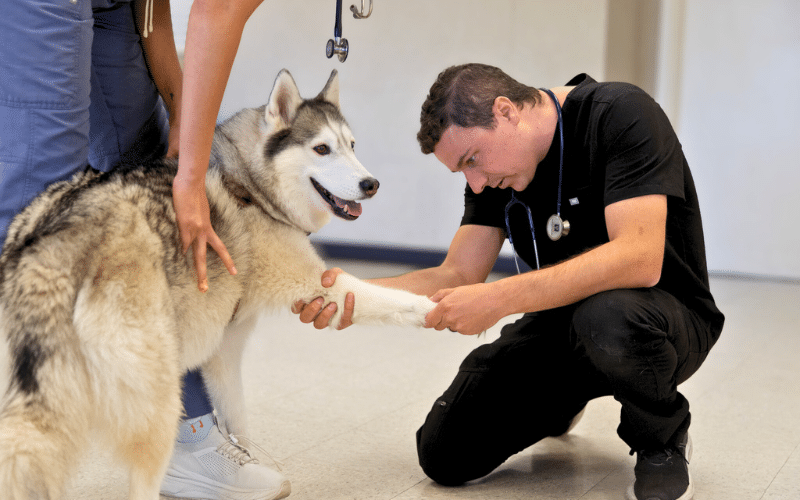
Dr. Sanders performs a wellness check on a patient.
What Community Medicine Means at HSSV
At HSSV, community medicine is not a single program or pop-up clinic. It is a model built on access, equity and trust, designed to remove barriers that prevent people from caring for the animals they love. That means bringing care directly into neighborhoods and designing services around transportation realities, financial constraints, disabilities, and moments of crisis. It also means recognizing that for many people, a pet is not just a companion, but a stabilizing force and an emotional anchor.
“When I think about meeting people where they’re at in the context of veterinary care,” Dr. Ramer explains, “it stems from the idea that all pets should have access to veterinary care. And while some owners have more resources than others, we should be able to provide a spectrum of care and provide reasonable veterinary care to all pets.”
Sometimes that spectrum means adjusting a treatment plan. Sometimes it means focusing on symptom relief instead of extensive diagnostics. Other times, it’s affordable care options, financial assistance, or meeting clients at a pace that feels manageable rather than overwhelming.
The goal is to broaden access to care, so pets do not lose care simply because their people are navigating a hard season.

That philosophy comes to life at HSSV’s neighborhood vaccine and wellness clinics, which bring preventive care into familiar, trusted spaces like parks, community centers and housing sites across San José and surrounding communities.
The clinics offer vaccines, microchipping, flea prevention and wellness support at intentionally affordable pricing. In many cases, pricing is about half that of a traditional veterinary clinic. For families facing acute financial hardship, additional subsidies or no-cost services may be available.
“Our clinics are designed to be affordable and approachable,” says Cecily Cigolini, supervisor of animal services. We structure pricing at our neighborhood vaccine clinics to prioritize access, ensuring cost is not a barrier to essential care.”
That affordability draws a wide range of community members.
“The people we serve come to us for many different reasons,” Cecily says. “Some are navigating financial constraints or fixed incomes, others are students or first-time pet guardians, and many simply appreciate the ease of a walk-in vaccine clinic. We also see community members who visit our clinics to ask questions and stay informed about their pets’ care.”
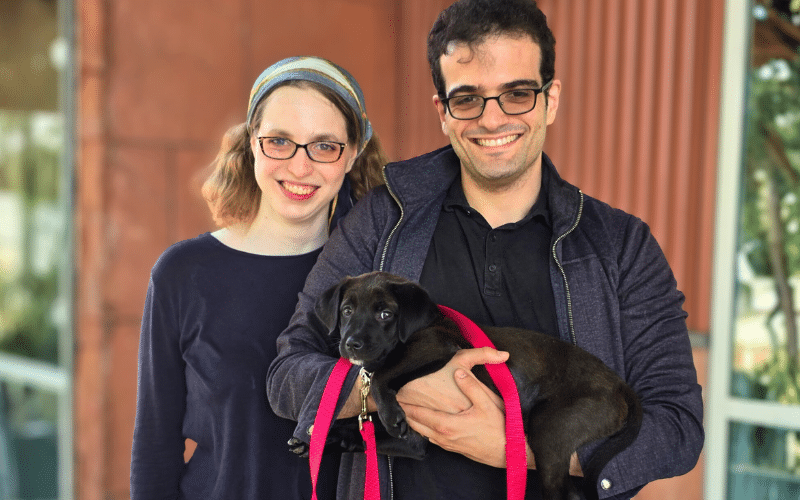
Naomi and her family and their new pup – Lila!
For Naomi, the vaccine clinic became the foundation of her dog’s first year.“Everything that the puppies needed for basically the first year of life, we did through them,” she says. The savings did more than reduce stress. They created resilience.
“We were able to afford an emergency vet visit later,” Naomi explains, “only because we saved money through the clinic.”
Housing partners see another layer of impact. Preventive care can be the difference between qualifying for interim housing or being turned away.
“One of the requirements for interim housing is that pets are vaccinated and up to date,” says Maggie Crowder, director of street-based services at HomeFirst. “There’s a huge need for animal services at encampments. People want to do right by their pets. They just don’t have access.”

Essential Care Beyond Vaccines
When pets need more than routine preventive care, HSSV’s Essential Care team provides accessible veterinary services designed to meet a broader range of community needs. Care may include exams, treatment for illness or injury, spay-neuter surgeries, and urgent interventions. Some services are offered at no cost, while others are subsidized to ensure care remains within reach.
For Paul, who was living unhoused with his dog, Cody, that support was life-changing.
“They provided care for Cody and it was free of cost,” Paul says. “It took away the stress and the financial burden of an extremely expensive vet care bill.”
Trust is built through consistency. Showing up in the same places, on a predictable schedule, with familiar faces matters.
“They’re easy to work with,” says Luna Alvarez, peer specialist at Abode Services. “They make it smooth so residents feel comfortable enough to come.”
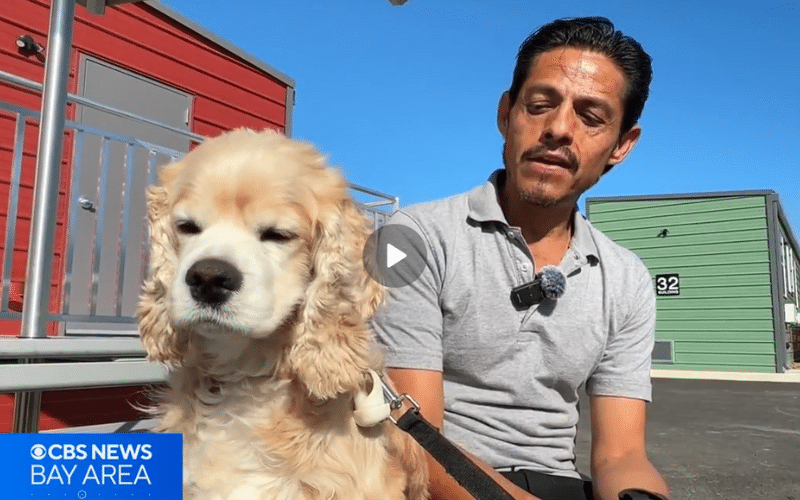
Carlos sits down with CBS News Bay Area to share his experience with HSSV and HomeFirst.
One example is Leo, a dog she treated in the field for a severe dental infection while his owner was unhoused and difficult to reach.
Months later, Leo arrived at the shelter as a stray.
“We recognized him,” she says. “I was able to do the dental, and he was returned to the owner.”
The moment underscored that access is not just about a single visit. It is about continuity, trust, and relationships that hold—even when circumstances change.
Even small gestures carry weight.
“Something so simple like remembering their names goes such a long way,” Luna adds.
Dr. Ramer sees the impact of community-based care unfold over time.
Education, Trust, and Showing Up Without Judgment
Providing care also means taking time to explain it. Naadia Wilson, spay and neuter supervisor, sees education as one of the most important tools in community medicine.
“How we communicate matters,” she says. “By avoiding medical jargon and creating space for questions, we help reduce anxiety and make care feel less intimidating.”
Before surgeries on HSSV’s public spay-neuter bus, the Wellness Waggin’, the team gathers owners to review medications, home care and warning signs. The floor is open for questions.
“It often helps owners hear others ask things they were too nervous to bring up themselves,” Naadia explains.
Nadia Chabaria, a veterinary assistant, wishes more people understood that gaps in care are rarely about apathy.
“Most owners truly love their pets,” she says. “They simply haven’t been given the information they need, or they are navigating stress, fear, or mental health challenges that make asking for help difficult. Lack of care is almost never a lack of love.”
That approach is intentional, according to Tschudy Smith, community manager at HSSV.
“When we decided to go out into the community, we knew it wasn’t just about what services we would provide,” Tschudy says. “We were working alongside individuals for whom trust and safety had often been broken.”
HSSV’s community teams approach each visit with empathy, curiosity and respect.
“We start by listening,” Tschudy explains. “When we show up with empathy, curiosity, and respect, people feel seen. Over time, and through consistent visits, that trust deepens and safety follows.”
That trust shows up in small but meaningful ways. Smith recalls a recent clinic visit with a woman who needed vaccines and flea treatment for her dog. The clinic was busy, and the crowd became overwhelming.
“She trusted me enough to tell me she needed to leave,” Tschudy says. “Because of that trust, I was able to find a quiet place for her and make sure she and her dog still received care.”

Community medicine works because it is shared work. Housing providers, outreach teams, case managers, HSSV staff and community members all contribute to the ecosystem.
“We can’t do this alone,” Maggie says. “Everybody has their niche. We need each other.”
She sees the emotional impact when HSSV shows up.
“When HSSV shows up, people feel seen. They feel cared for. It changes the way they show up for their animals, and for themselves.”
Jesse Gomez, associate director of philanthropy and community affairs at PATH Santa Clara County, has seen how quickly pet support can stabilize households.
The impact extends beyond finances. Trust deepens. Conversations widen to include next steps, and long-term stability. Clients are more open to shelter placement and additional services when they know their pets will continue to be supported.
“When someone knows their loved one is taken care of,” Jesse says, “they can finally breathe.”
Pets as Emotional Anchors
Across every story, one truth remains constant. Pets are not luxuries. They are family. They provide structure, comfort and purpose, especially for people navigating instability or trauma.
For Kimberly, Flor is her connection to the community. For Naomi, her dog is family. For Paul, Cody is the reason he keeps going.
“He saved my life,” Paul says. “And I saved him.”
Protecting that bond is central to community medicine. It keeps pets healthier, but it also keeps people connected to support, stability and hope.
A Connected, Compassionate Future
From neighborhood parks to supportive housing sites, HSSV’s community medicine model shows what is possible when care is designed around real lives. Affordable vaccine and wellness clinics make essential care easier to access. Mobile and on-site services respond to people’s circumstances rather than asking them to fit a rigid system. Partnerships ensure families are supported and not navigating challenges alone.
As demand continues to grow, the need is clear. People want to care for their pets. Access — financial, emotional, and practical — is what makes that possible.
Community medicine delivers it.