

For more than eight years, Dynell has been feeding and caring for the cats that make their home around the shelter. She shares how she earns a wary cat’s trust, and why some cats, like Bob Bob, are happiest staying outside.
In the back lot, Dynell calls one name.
“Maddie May, Maddie May.”
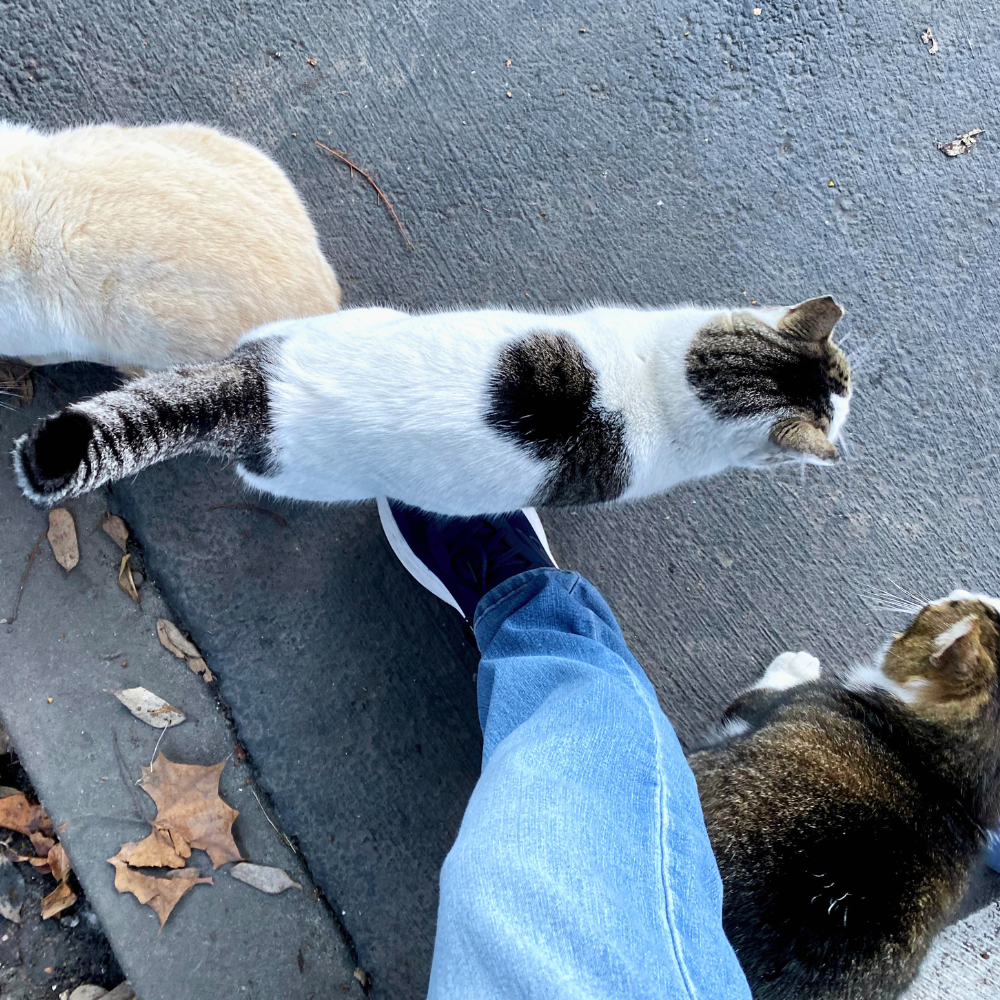
Every cat back there comes running, Maddie May herself included, “and their little tails are up in the air,” Dynell says. They rub against her legs. Scruffy runs right beside her, and partway there he turns his head to look back at her.
“To make sure I’m still coming,” she says.
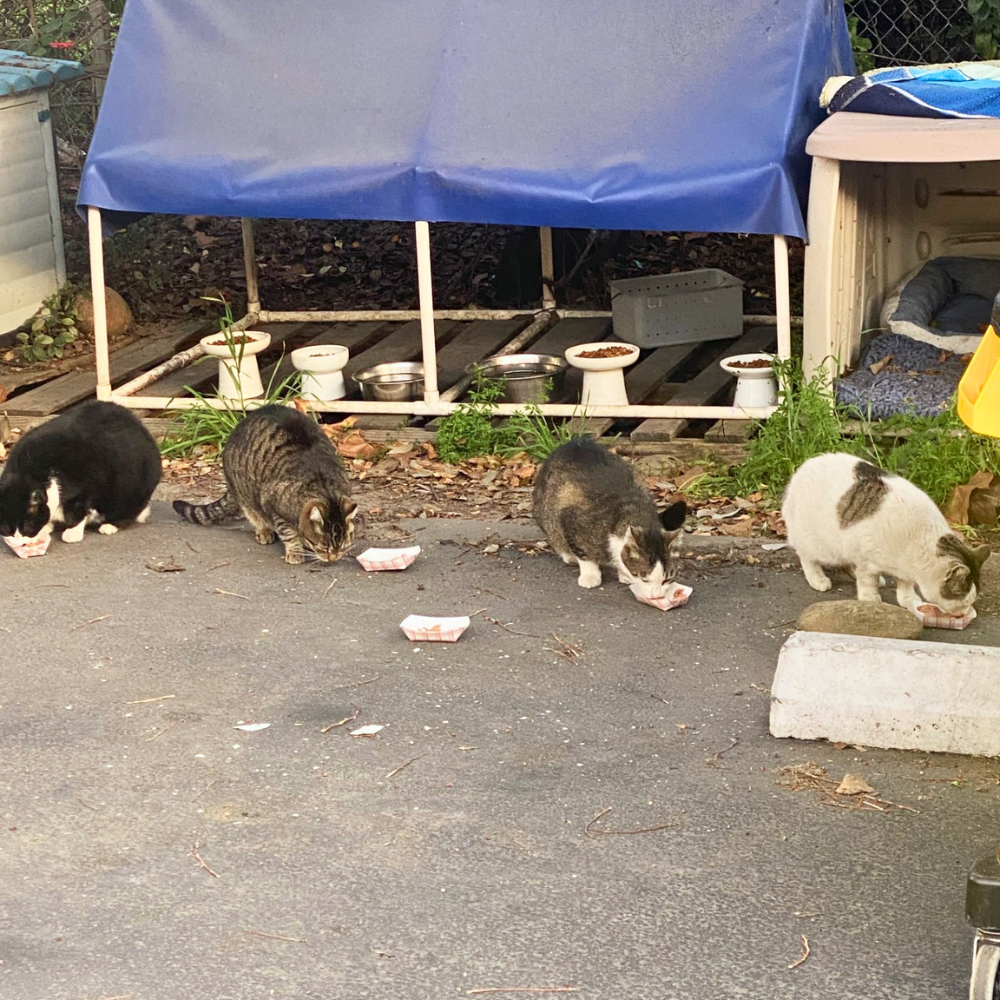
At the feeding station he head-butts her while she puts down fresh water and canned food.
Dynell is an Animal Care and Enrichment Technician at Humane Society Silicon Valley, and she feeds the community cats who live on HSSV’s Milpitas campus. When she counted them earlier this year, there were eleven. Most people would call cats like these feral, and Dynell uses the word herself for the ones who want nothing to do with people. She can also tell you that Ringtail and Scruffy sleep side by side in the bushes, which cats share a dish, which one is a bully, and roughly how long it took before each of them let her touch them.
Scruffy took six months. Bob Bob took two years.
Out front, she calls for Bob Bob. Only one cat answers to that name, but the others out front know what it means at that hour, and they come out of the bushes too.
One of them is BJ, a little brown tabby who looks like a six-month-old kitten and is about five years old. She has a cat house of her own out front. BJ socializes with exactly one other cat, Bob Bob. They eat together. Not everyone who works at HSSV knows she has a name.
“Bob Bob was dumped here,” Dynell says.
He turned up more than eight years ago in the parking lot, along with a black-and-white cat named Oreo. Back then she worked only with HSSV’s large dogs. She knew the two cats were new because she knew the colonies across the street, and these two didn’t come from either of them.
“They were buddies,” she says. “They were always rubbing against each other. If you saw one, the other one was there.”
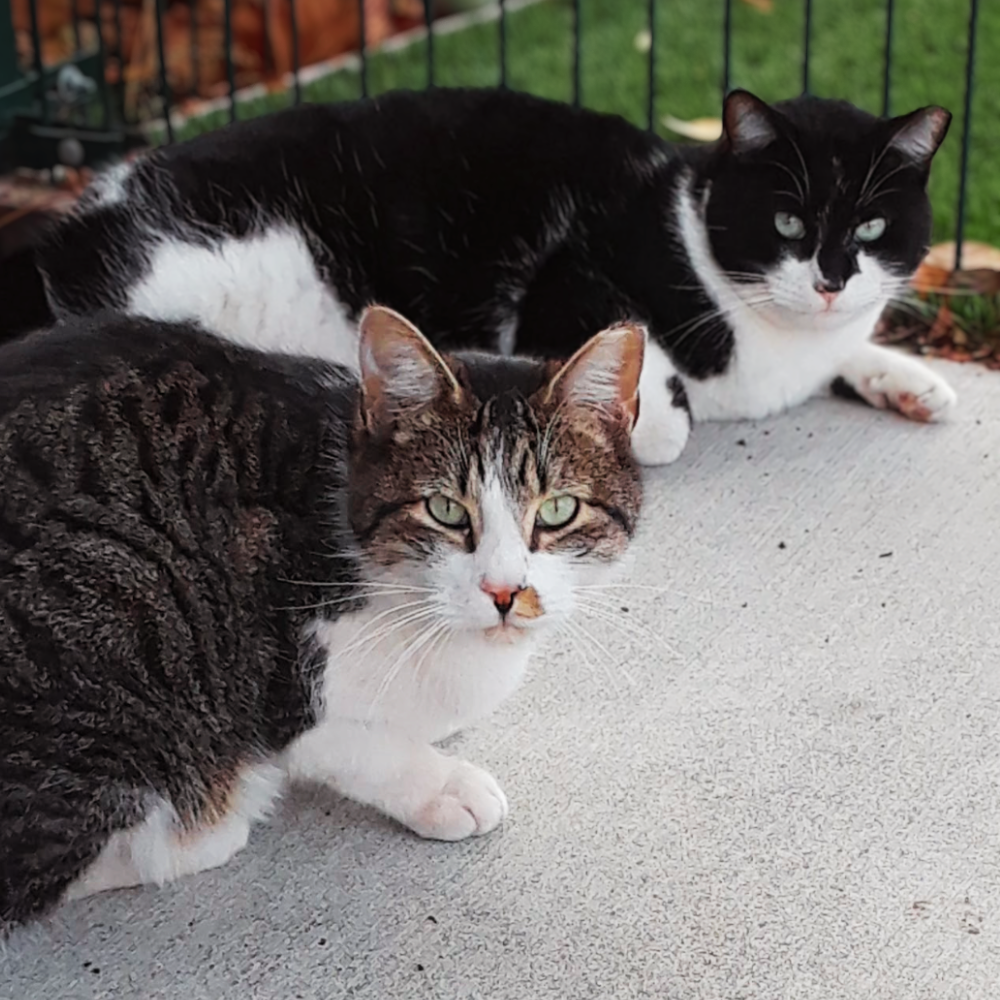
Neither one wanted anything to do with people. Nobody else was feeding them, so Dynell started, in the mornings, on her own.
“I would just feed them,” she says. “Just because I saw them and I knew they were new.”
At first, she says, cats like that stay about twenty feet away and just watch to see whether you’re dropping food. Her method is to let them. “You ignore a community cat when you first start feeding them,” she says. “Because they don’t want your attention right now. They just want your food.”
It took about two years before she could touch either of them. Eventually the pair moved over to the front of the building.
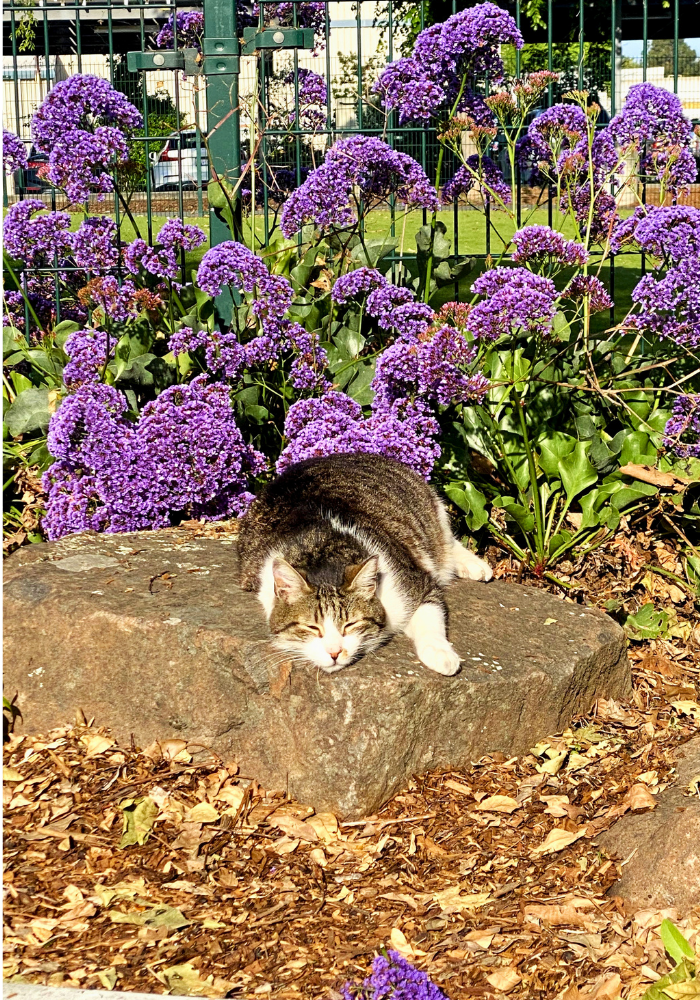
Bob Bob is twelve or thirteen now, by Dynell’s estimate, and he lets almost everyone pet him, visitors included. “As long as you don’t chase him,” she says. “If you call him and just sit down, he’ll come up to you.”
When she first started learning about community cats, this was the part that surprised her. “That they’re actually affectionate once they know you.”
Only three people can pick Bob Bob up, and Dynell is one of them.
People ask about him, and Dynell tells them he’s the resident cat and that he’s taken care of. Once a little girl decided she wanted him, and her father asked how much he could offer to adopt him.
“He not for sale,” Dynell says. “Honey, he’s our cat. You cannot have him.”
At one brief period, there was a Siamese among the campus cats, one who came out only in the early morning or the evening when hardly anyone was around. With the people who fed him he was affectionate, and he’d walk right up to them. Dynell felt strongly that he’d lived in a home once. So one evening, after the campus emptied out, he was brought inside and brought to an adoption room.
“He was there for maybe an hour,” Dynell says, “and he was coming out already to the people he knew.”
He was adopted within about two days.
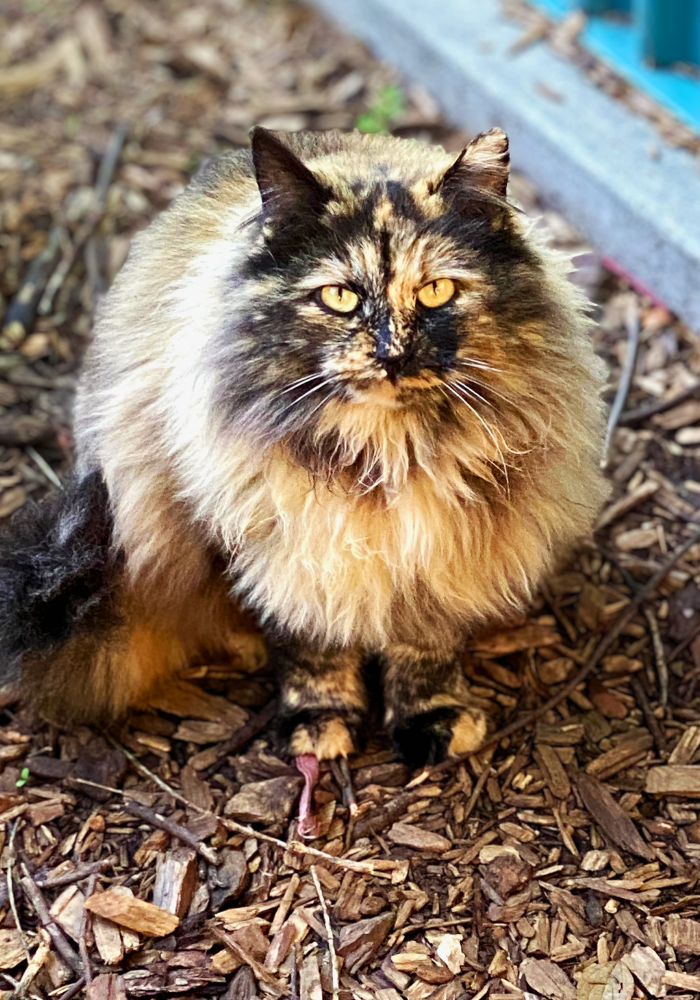 Dynell gives the cat most of the credit for how that went. “The cat kind of decides for themselves,” she says. The signs are in how a cat takes being picked up, and how it takes a closed room.
Bob Bob decided the other way. He’ll wander into the shelter on his own and walk around, but if someone closes a door behind him, he panics.
“He’s like a feral cat,” she says. “Running back and forth all crazy. He could never be inside where he cannot go out.”
At one point there was consideration about moving him into Kona’s Spot in the Sun, the enclosed cat garden on campus. For most cats it would be an upgrade. Bob Bob won’t go in there. To him, it’s prison.
Dynell isn’t a community trapper, though she has trapped cats on campus. For trapping out in the neighborhoods, she points to Sophie, HSSV’s TNR Specialist. But Dynell already knew a fair amount about Trap-Neuter-Return when Bob Bob showed up. Where she used to live in San Jose, a woman about three houses down cared for a colony of around thirty cats.
Ask her whether kitten season reaches the cats outside and she answers with geography. “It depends on where you’re at, as to how many TNRs have been done in that specific area,” she says. “In some areas, you’ll have a high volume of kittens coming in from there. And other areas, you hardly have anything,” because the people who feed those colonies try to trap any new cat as soon as they see it.
On mornings when there are bottle babies in the building, Dynell feeds them first.
Scruffy, the cat who checks over his shoulder at breakfast, was in rough shape when he first showed up. He was skinny and scratching constantly, with scabs everywhere and his hindquarters raw and bright red. It took six months before Dynell could touch him, and once she could, she worked out what was wrong.
“Oh, you’re allergic to your skin mites,” she recounts.
She told Dr. Jen, one of HSSV’s veterinarians, who agreed. Dynell has given him a monthly topical treatment ever since.
By her account, Scruffy is also “the one that likes to fight,” which makes the summer of 2025 harder to explain. A kitten turned up in the back lot, three or four months old, and Scruffy took him in. For two days the kitten ate with Scruffy and stayed by him, until staff trapped the kitten and brought him inside. He was neutered and adopted.
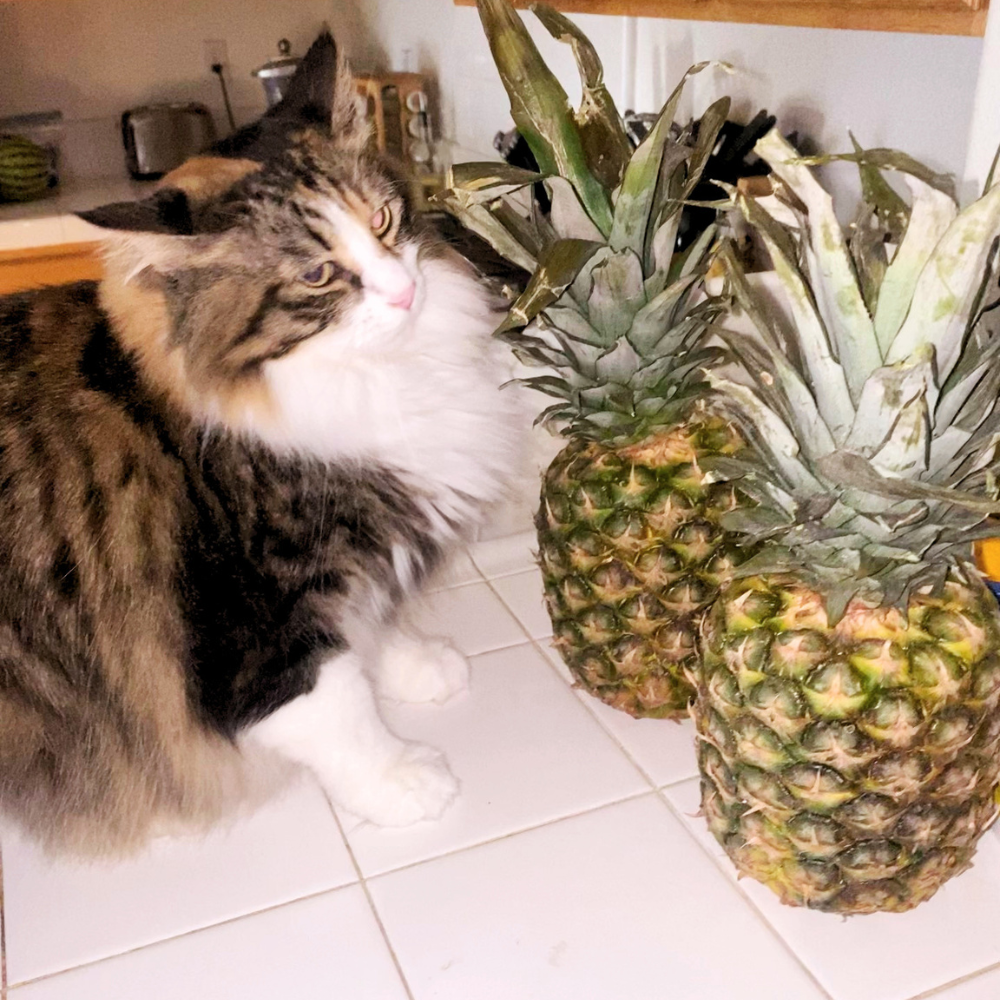
“They’re the same as my cats,” she says, describing the campus cats. “They just live outside.”
Some of hers started outside, too. Bam Bam lived around her house for about two years before he came in. “He owned that neighborhood,” she says, and he didn’t want other cats near the house.
Then, just like Scruffy, he met a small kitten. It was a bad kitten season, and the shelter was full. A kitten came in at two days old, cold and dehydrated. There were no fosters to take him.
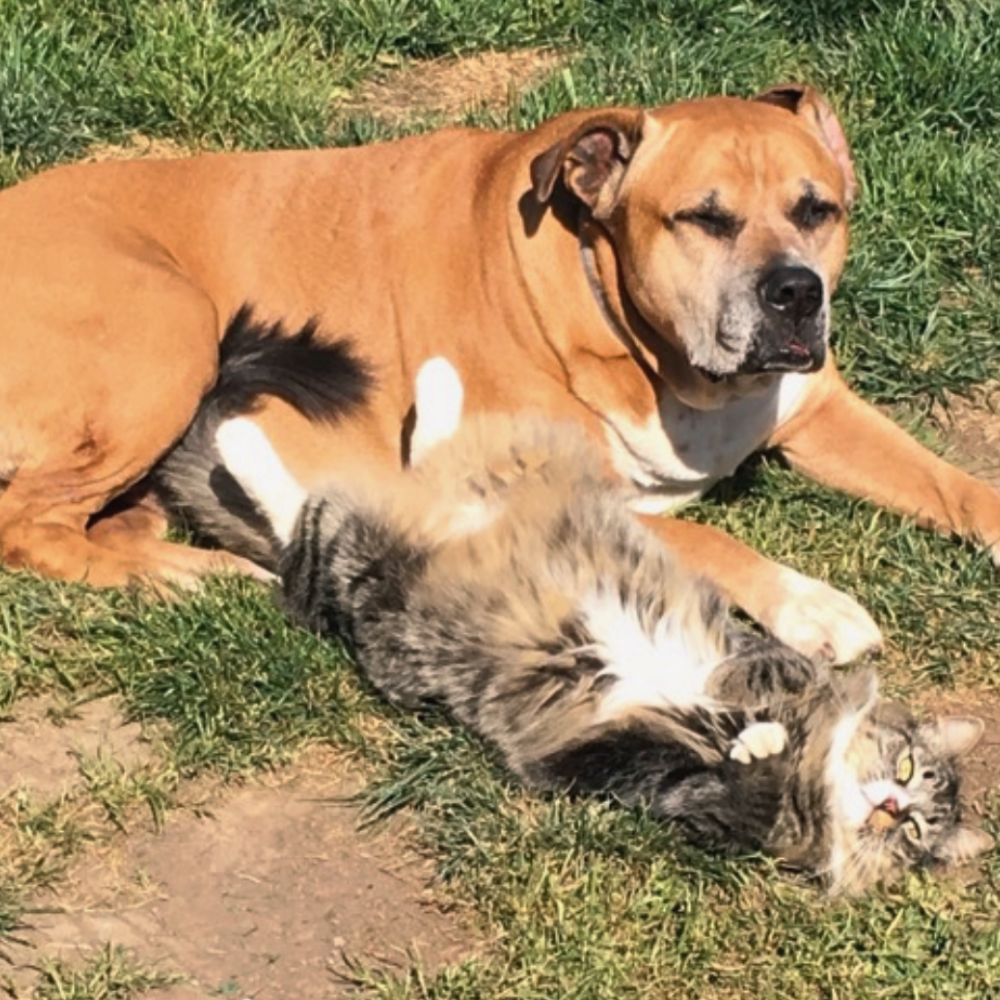
“I said I’d take him. I was worried for him.”
That was Littles. She warmed him up and got maybe one cc of food into him, if that. At home she kept warmers on him and fed him constantly. And Bam Bam took over like a mother cat, washing him.
So did Pharaoh, her pit-mastiff mix. Littles slept with the dog a lot, and in the mornings, when Dynell let Pharaoh into the backyard, Littles went out with him to do the rounds.
He’s grown now and still only about seven and a half pounds, which is small for a male, so the name still fits.
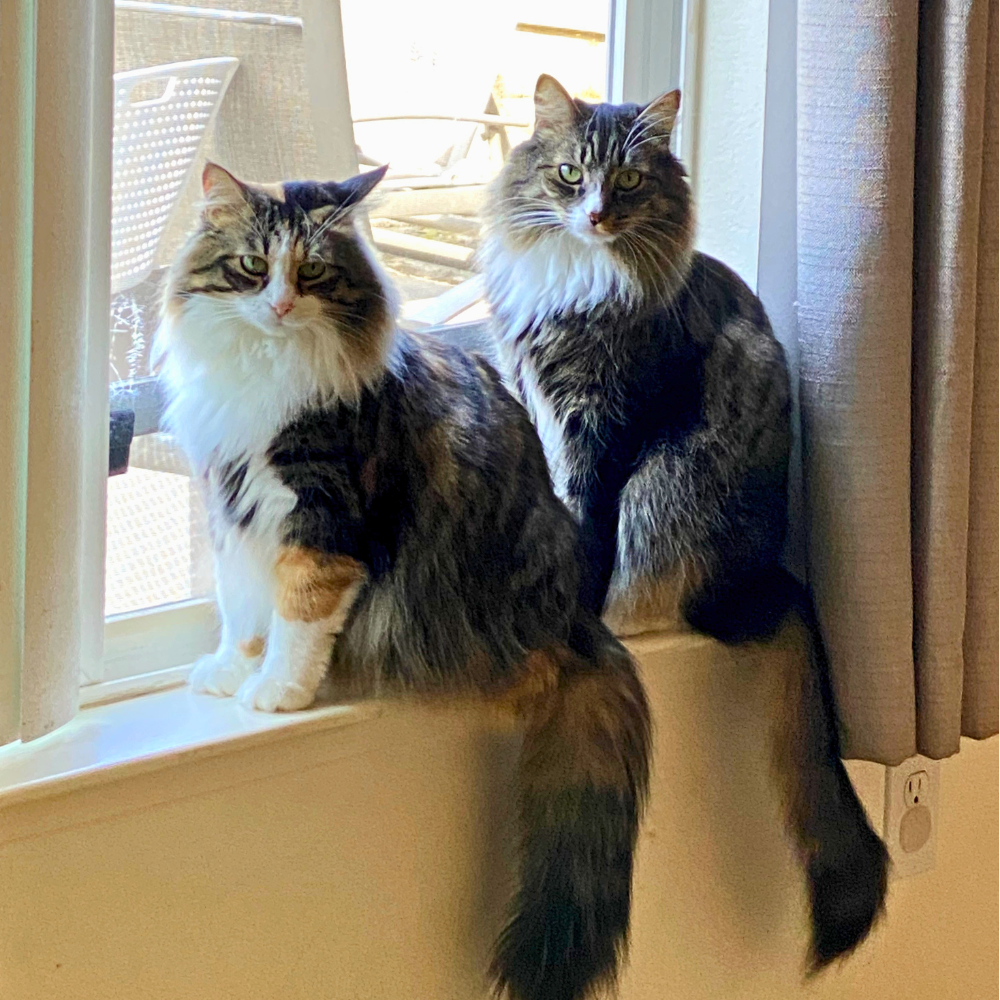
Tessa came into HSSV at about three months old, trying to bite and scratching at everything, right at the cusp of the age when a fearful kitten can still be turned around. She was about to be moved to a nursery for kittens in behavior modification.
“I said, no, leave her here, because I’m gonna take her home,” Dynell says. “Once I can touch her.”
It took ten days before Dynell could touch her without Tessa trying to bite. Then she took her home. Tessa gets along with the dogs and the other cats. With people it’s simpler.
“She only likes me.”
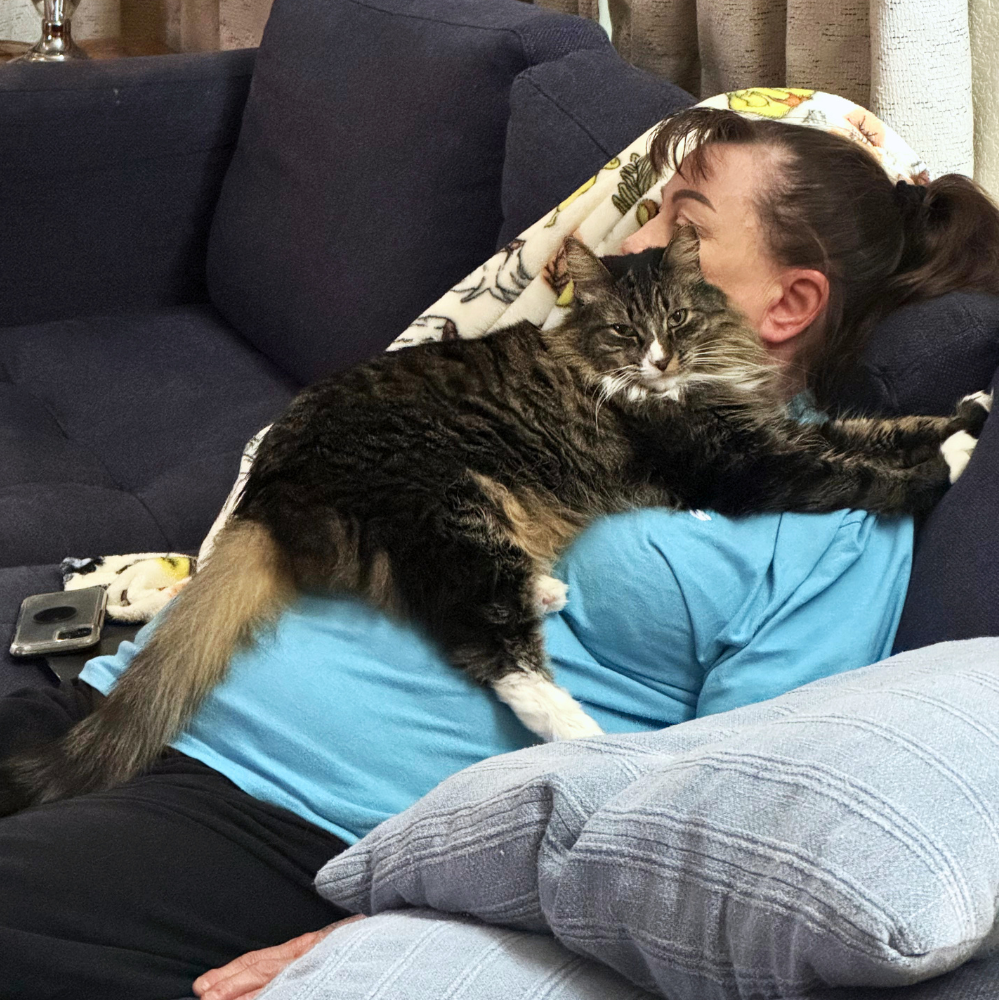
Back on campus, new cats keep finding the colony. A newcomer hangs back from the food and waits, Dynell says, edging closer to see how the others react. “They kind of have to test the waters to see if they’re accepted. And then if not, they’ll move on and find the next place.” Sometimes the others chase it off. Sometimes Scruffy takes one in.
The ones who stay greet each other at breakfast by rubbing the sides of their faces together. Maddie May doesn’t sleep with any of them, but she rubs all over all of them. Once a cat trusts you, Dynell says, it starts doing the same thing to you.