

“They don’t know that they’re missing anything. They’re fine. It’s the humans that need to learn to adapt,” says Behavior Specialist Gee.
It’s National Deaf Dog Awareness Week, and today we celebrate the deaf dog. Three happy tails, and advice from our expert.
Marshy
“My criteria was simple,” says Molli. “I wanted a dog to hike with, was a rescue, and would be my bff. Easy, right?”
Her wife, Daisy, was the one searching the area rescues. One day she sent over a profile with a question attached: how about a deaf dog? The picture convinced her first. It was the blue eyes.
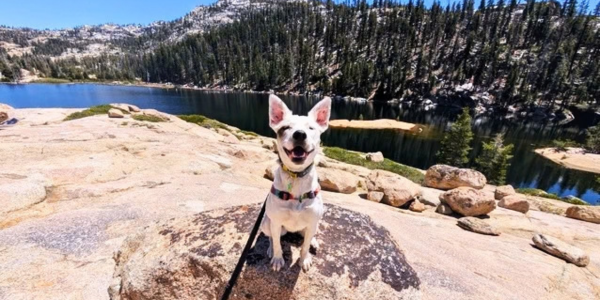
Gee sat them down and walked them through what a deaf puppy would ask of them. “Gee was so informative and positive that I knew we could take on this challenge,” Molli says. She felt the connection right away.
It took Marshy several months to feel the same, but Molli and Daisy were patient, knowing it took time to build the kind of trust Marshy needed.
The first few months were exciting, challenging, fun, and hard. Gee doesn’t romanticize it.

Marshy was about four months old, a husky and cattle dog mix, and high drive on top of being deaf. “They struggled at the beginning, but they figured it out,” Gee says. “They found help, and they asked for help, which is important.”
They got Marshy into training in several places at once. Gee referred them to an East Coast trainer who specializes in deaf and blind dogs, and did a couple of onsite sessions with them herself. They also found a local trainer with deaf dogs of her own, who opened up a whole dog community to them. “We learned so much about her because we learned how to communicate with her,” Molli says.
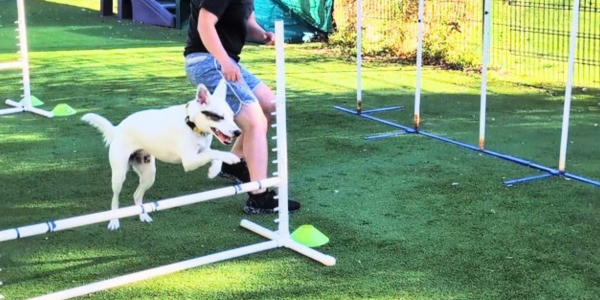
“Marshy is actually very, very smart – like, super smart — so she caught on fast.”
Marshy is a little over a year old now, and the household runs on her schedule. They left their gym andset up a new one in the garage, which is now Marshy’s gym, where Coach Marshy instructs their weekday morning workout from various spots around the garage. She has about fifteen beds and a best friend named Amali from HSSV’s Puppy Kindergarten.
They bought a cabin in the mountains,
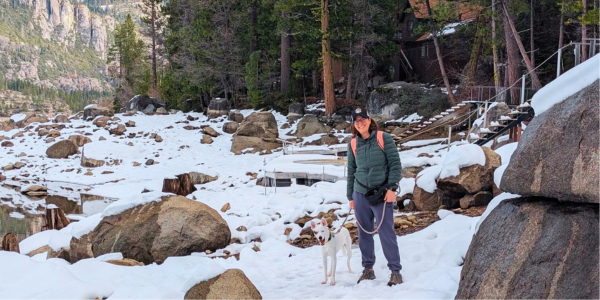
Marshy’s Mountain Home, where she hikes and paddleboards. She does agility, in class and on a setup at the house, and she’ll perform on the gym equipment without being asked.
Her favorite game is chasing the dog who chases the ball. She has no interest in the ball.
Gee won’t promise that every deaf dog will turn out like Marshy. “Results definitely may vary,” she says. “Genetics. What the parents
were like. And your commitment. I say that about any dog, no matter if they can hear or not.”

People at the park tell Molli and Daisy they’d never have guessed Marshy was deaf, because she “listens” so well. It took a long time and a lot of help to get there.
What makes Marshy special? “The way she really looks at us. That moment she finally trusted us, it was like this feeling I cannot describe.”
Jump to: Beginner’s Guide to Living with a Deaf Dog • Advice from Adopters • Baxter • Daisy • The Expert
Baxter
What got Mea was his face. Baxter’s online photos showed a curious little dog who looked, to her, like he’d be sweet and loyal. “He had a look in his eyes that made me know we were going to be together for a long time,” she says, “and so far, he has proven me right.”
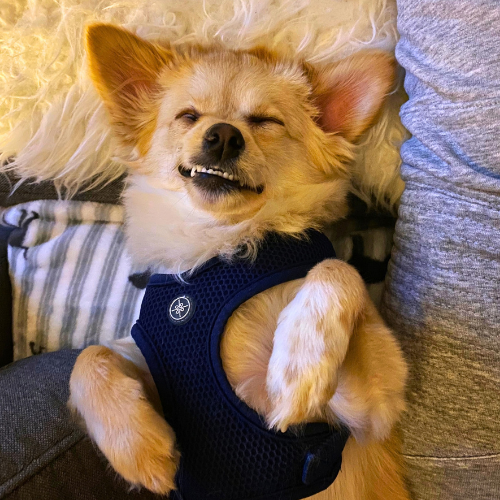
Before she committed, she and her sister had questions. How would they communicate with him? How would they get his attention? Were their home and surroundings safe enough for him, or did he deserve more than they could offer? They tried their best to find answers.
Gee, who was fostering him at the time, walked them through the patience it would take and the ways they’d need to adapt. Mea started following deaf-dog accounts online, and the picture began to shift. “I quickly realized that our life together would be much more normal than I had built it up to be in my head.”
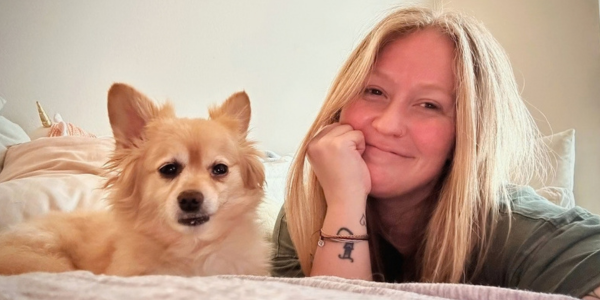
It was the pandemic, so the adoption happened over Zoom: Gee sat with Baxter in a small pod at the shelter while someone held up an iPad. Mea met him in person for the first time on the day she took him home.
Learning to talk to him took the longest. He became her favorite person to talk to anyway, “mainly because there’s no talking back!” He picked up signs they taught him and he built his own map of the house: the laundry room door meant a walk, the bottom-right cabinet meant treats.
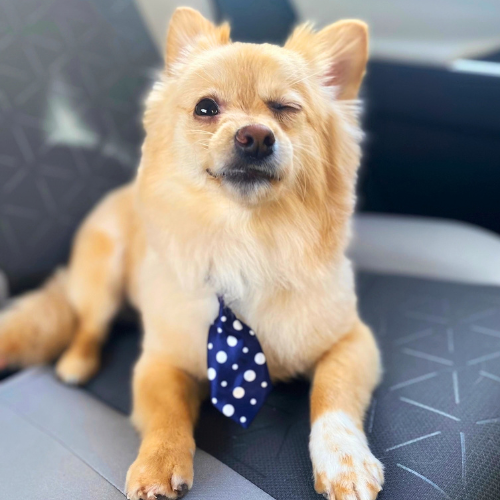
Her favorite moments from that stretch were the reminders that he really couldn’t hear. The vacuum didn’t faze him. A smoke alarm couldn’t wake him. Nobody at the door ever got a reaction. “I quickly learned he was a terrible guard dog,” she says, “but man, do we take the best naps!”
The hardest thing to get right was danger. Baxter is also visually impaired in one eye, so he navigates by smell, and a curious nose finds dropped food in the kitchen and freshly sprayed chemicals on a lawn. Mea had to work out how to signal not that without it reading as anger, and to teach him that curiosity is fine from a safe distance.
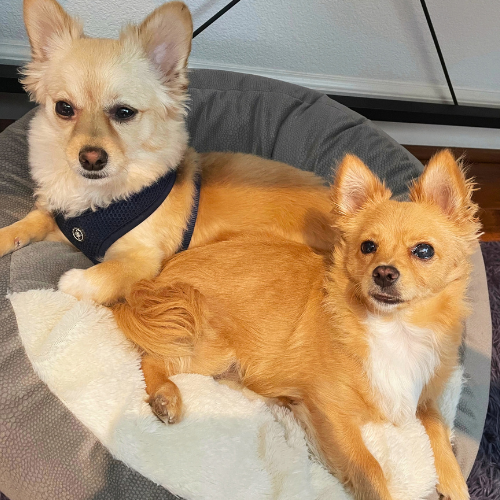
Anything going over his head worried him, which Gee says isn’t unusual for deaf dogs, since they can’t hear what’s happening up there. Once his harness was fitted, he was fine. “He just needed to learn to trust people,” Gee says.
Today the harness goes on and off without any fuss, and he’s even learned to tolerate the groomer.
He doesn’t bark much. Instead, he does what the family calls gator chomps: he sees other dogs barking, can’t hear the sound, and copies their mouths. The result is a dog chomping at the air, and it has never once failed to make Mea laugh.
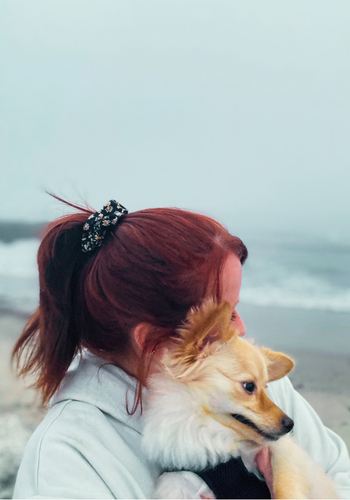
Baxter arrived when Mea needed him most. For a long time it was the two of them, before they adopted a second dog, Marshall. Baxter learned to read her – when to cuddle closer and when to stay nearby – and he taught her to slow down and take in what was around her. “There are never enough words to describe how this dog changed my life,” she says.
His face is going from blond to white now. She has decided that isn’t a sign of age but proof of every pet and kiss he’s collected along the way.
“He will absolutely be my hardest goodbye, but he has always been, and will always be, my favorite hello.”
Jump to: Beginner’s Guide to Living with a Deaf Dog • Advice from Adopters • Marshy • Baxter • Daisy • The Expert
Daisy
Daisy was losing her hearing to age, and it was the least of her troubles. She came to HSSV as a senior with a long medical history. Her legs were frail. Her fur was thin, and her skin was in such bad shape that she screamed if water touched it. Nobody knew how long she had. It might be a year. It might be three months.
Ali had always imagined that she and her husband, Glenn, would rescue a younger dog. They’d rescued a host of other animals – rabbits, cats – but the timing had never been right for a dog. Now, it was finally the right time, and they were looking for the right dog.
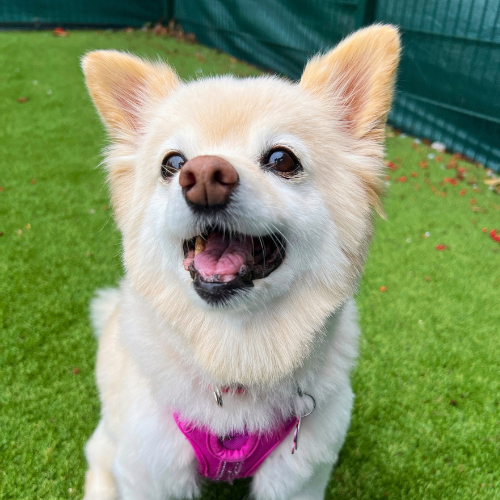
Despite all those years picturing a younger dog, Ali kept returning to Daisy’s profile. “I read her little resume and realized she needed help,” she says.
She’d saved the page. She couldn’t stop looking at it. Their house seemed right for whatever Daisy might need, both then and as she got older.
When they adopted her, they understood they were signing up for end-of-life care. They could afford her medication and make sure her last months were comfortable.
But something else happened.
“We got so much longer with her than we expected,” Ali says.
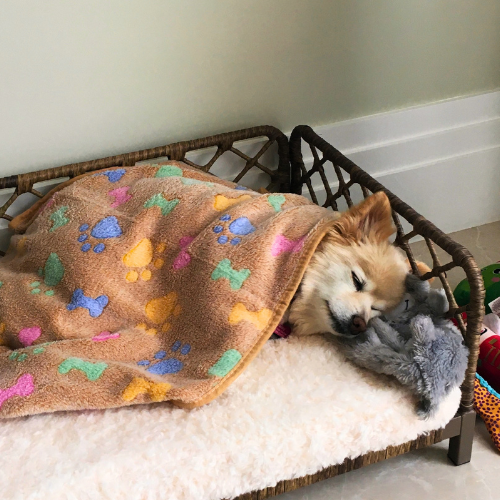
Food was Daisy’s real struggle. Any food, at any time, set her off, and she’d bark incessantly for her share. With Gee’s help, Ali and Glenn built a routine. Daisy always ate first, and when they sat down to their own meal, she got one of her pills wrapped in string cheese so she could eat alongside them. Slowly, the barking gave way to waiting. She’d sit and watch them with what Ali calls “the most beautiful smile on her face, because she knew something was coming.”
The turning point came at a Lazy Dog. They ordered her a rice bowl, and she ate and ate until she couldn’t take another bite. Then she walked away. Ali and Glenn had never once seen Daisy leave food behind.
“She finally trusted that there would always be another meal coming,” Ali says.

Her deafness showed up in funnier ways. When dinner was on its way, she’d bark at a volume she had no way of hearing and launch all four paws into the air. “There’s been countless times we’ve both levitated off the ground,” Ali laughs. She never went off lead. Once, on the beach, she wandered off after a different couple with her leash trailing behind her, and Ali and Glenn had to chase her down the sand.
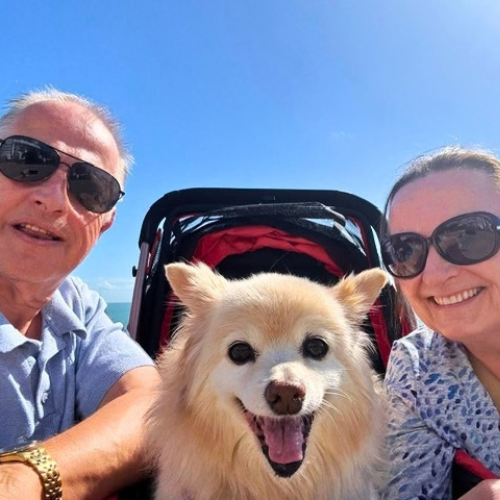
When they moved back to England, Daisy came too. She had a big garden where she could finally run off lead, and she did. “She absolutely thrived,” Ali says. Later, when walking got hard, they pushed her around in a pram. She’d never had much use for other dogs, and Glenn says she loved riding high enough to look down on them.
They plan to rescue again someday, and “we wouldn’t hesitate to rescue a deaf dog, or again, a dog at end of life,” Ali says.
“It was the best life that dog could have had,” Gee says, “the last senior years that she had with them.”
“I don’t think we’ve got a single photo where she’s not smiling,” Glenn says.
Jump to: Beginner’s Guide to Living with a Deaf Dog • Advice from Adopters • Marshy • Baxter • The Expert
The Expert on the Other End of the Line
These dogs span breeds, years, and an ocean, and they have one person in common: Gee, one of our Behavior Specialists and our resident expert in deaf dogs. She fostered Baxter and Daisy in her own home and helped all three families find their footing.
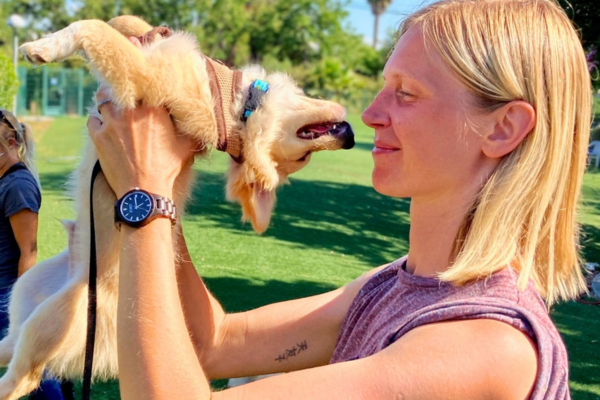
Gee’s love for deaf dogs began with her own pup, Paws. Gee adopted her at seven weeks old, and no one knew she was deaf. When Gee found out, she dove in, buying a book on the subject and following trainers who specialize in deaf and blind dogs. Now she can’t imagine not having a deaf dog after Paws.
“I love deaf dogs, whatever shape and form they come in,” she says.
For first-time owners like Ali and Glenn, that expertise came with a phone number. “You know intellectually you’re going to have shaky moments and wobbles,” Ali says. “To know that you have somebody at the end of a phone or email that you can call on is so reassuring.”
Jump to: Beginner’s Guide to Living with a Deaf Dog • Advice from Adopters • Marshy • Baxter • Daisy
Beginner’s Guide to Living with a Deaf Dog
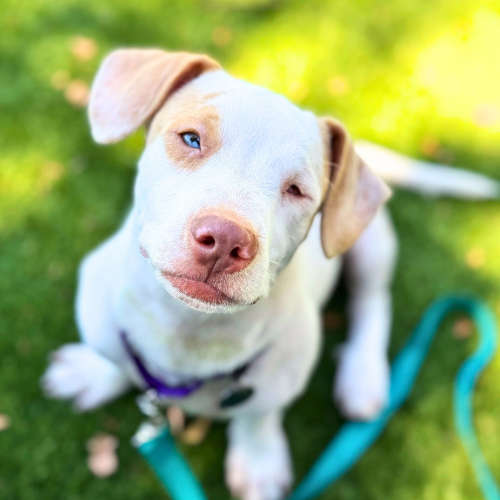
Some dogs are born deaf. Some, like Daisy, lose their hearing over time. Either way, the dog usually adjusts long before the people do. Here’s how to catch up, first from our resident expert and then from the people who’ve done it.
Don’t pity the deaf dog. “Deaf dogs are just regular dogs,” Gee says. “Don’t feel bad for the dog, because you’re not doing them any favors.” They still need training. Treat them differently, and you risk skipping the discipline they need.
Train the same, signal differently.
- Use a thumbs up in place of a verbal “yes” or a clicker.
- Maintain eye contact. “You can show them to come to you all day long, but if they’re not looking at you, then that’s not going to do it.”
- Teach a “watch me” check-in. Touch your nose with your index finger, and the moment your dog looks at you, give a thumbs up and a treat.
- Sign all day, not just during training: when you fill the water bowl, at mealtime, before you head outside.
- Make sure everyone at home uses the same signs. A cheat sheet on the fridge helps.
Invent your own signs. Plenty of people borrow from ASL, but feel free to create unique signals. “Honestly, who’s holding you back?”
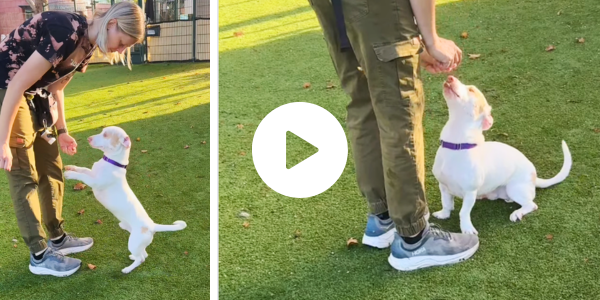
Watch a training session with Gee.
Hold off on off-leash. Gee won’t risk it until she’s “one million percent sure,” and even then she keeps watching. One interesting smell or one coyote on a trail, and your dog is gone with no way to call them back.
Instead, use a fifty-foot long line and teach the automatic check-in. Every time your dog looks back at you, thumbs up and a treat. Do it enough and they’ll start doing it on their own. At home, secure fencing matters. A deaf dog can’t hear traffic – or you.
Pro tip: Sniffspot rents private yards and properties by the hour. For off-leash time, look for spots listed as fully fenced.
Talk to your dog anyway. “If I stand and look at my deaf dog and say in monotone, with a straight face, ‘Hi, Paws, how are you doing today,’ she may not have a reaction. But if I say the same thing in an excited voice and a smile on my face, she’s going to wag her tail.”
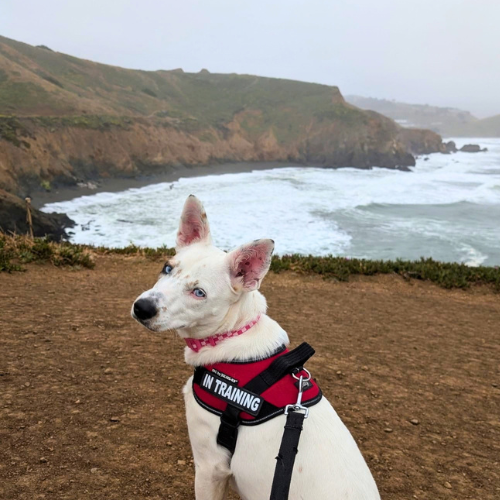
The words were never the point. “Just like we are reading their body language, they’re reading ours, and they watch our face,” Gee says. “Even if you talk to a hearing dog, let me tell you, half the time they don’t understand what you’re saying. It’s noise coming out of you.”
Expect some perks. “You know what my dog is not afraid of? Thunderstorms and fireworks.” Paws has done Pride in San Francisco, a plane, and BART without a care. It depends on the dog and the mix, Gee says, but without that extra stimulation, deaf dogs can be calmer in busy places.
Approach where they can see you. A deaf dog can’t hear you coming, and some startle and snap. “That’s just a normal reaction. It’s not all dogs, but some dogs could.” Gee’s training guides cover waking a sleeping dog and getting a harness on, and she recommends the “touch and treat game.”
Start signing before you need to. Hearing loss with age is “extremely common,” Gee says, and she thinks it’s the harder adjustment of the two. “Normally you call your dog, and here they come tip-tapping down the hallway. And now you’re calling, and they’re fast asleep.” Watch for a dog who sleeps more deeply than usual or doesn’t wake when you call their name. Pair a hand signal with every verbal cue now, whatever your dog’s age. A dog who knows the sign at five won’t have much to relearn at twelve.
Jump to: Advice from Adopters • Marshy • Baxter • Daisy • The Expert
Advice from the Adopters
Molli, who adopted Marshy: Training, training, training – specifically with trainers who have worked with deaf dogs before. “We could not force Marshy to adapt to our previous lifestyle.” Learn your dog first. “It’s mostly about the dog’s personality. And to get that personality out, at least with Marshy, we had to learn her. And she had to learn and trust us.” Explain, sign, and talk to her, all at once. Noise won’t bother her: Marshy learned to play at puppy class alongside the loudest dogs in the room.
Mea, who adopted Baxter: Learn your dog’s habits early, including how they read other dogs. Baxter has no stranger danger at all, but a dog park can tip his curiosity into stress as he tracks what’s coming up behind him. Start small with new people and new places, and let confidence build at your dog’s pace.
Pro tip: Baxter’s leash says “Deaf Dog.” “That small detail has made many interactions smoother and more comfortable for everyone involved.”
Ali and Glenn, who adopted Daisy: If your dog is anxious around food, build a routine. Feed your dog before you eat, and find a way to include them when you do. Keep the lead on. “Being deaf, you just have to watch them closer,” Glenn says. And enjoy the quiet: “She was fine with the fireworks. There was none of the fear that some other dogs have.”
Jump to: Beginner’s Guide to Living with a Deaf Dog • Marshy • Baxter • Daisy • The Expert
Other articles you might enjoy: