
Last year, Scott told us how he helps families say goodbye to their pets. This year, he wanted us to meet the people who do it with him.
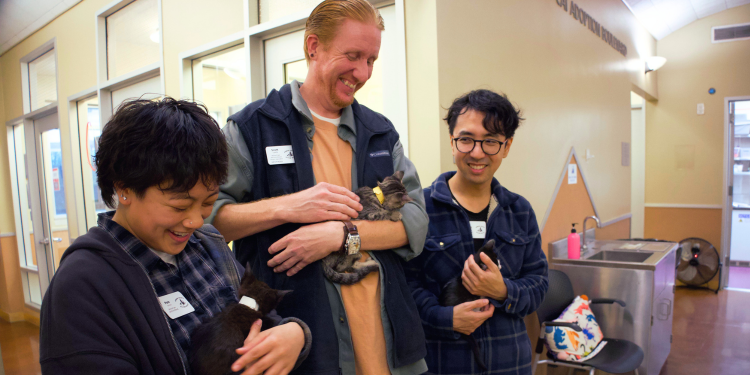
Last year, we shared how Scott, the Animal Care and Enrichment Project Specialist at HSSV, holds space for families to say goodbye.
He told us that in these toughest moments, he needs to be a rock. Someone to hold space for overwhelming grief. “People are looking for competence, someone who knows what they’re doing,” he said. “You’ve got to stay calm when the family is struggling.” Every family needs to hear something different in those moments, and somehow Scott always seems to know what to say. “That part matters.”
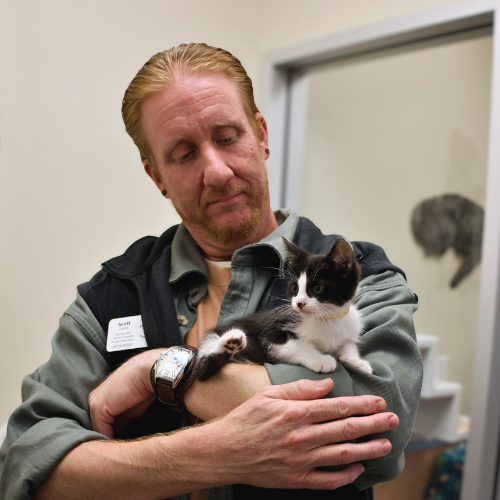 Appointment after appointment, he gives animals the peace and comfort they deserve in their final moments, and families the assurance they need to know their pets are in good hands. He is there to make sure the animal is okay and the family feels like things will be okay.
It’s not a job that can rest on one person’s shoulders. This year, as Scott nears 20 years at HSSV, he wanted us to meet two of the people who shoulder it with him, Elliott and Pam.
“There’s a reason it’s at minimum a two-person job,” says Elliott. “I’m thankful for all my teammates. We’re fully unified in our empathy for clients and trust in one another.”
Every Animal Care and Enrichment Technician at HSSV is required to become a certified euthanasia technician, and most of the learning happens long before the certificate. New technicians start by shadowing appointments, then spend months assisting as handlers. Elliott worked alongside Scott for almost two years before he was certified. Pam started at HSSV in June 2025 and was already assisting two or three times a week by the time she earned her certification less than a year later, in a class Scott co-taught here.
Scott coaches them the whole way. When a new technician has been in the room with him, he checks in afterward. Are you guys okay? How’d that go? How did it feel? Those check-ins are routine at first, says An, who manages HSSV’s ACE team. After that, Scott watches for what people don’t say. “He’s really good at reading faces,” An says.
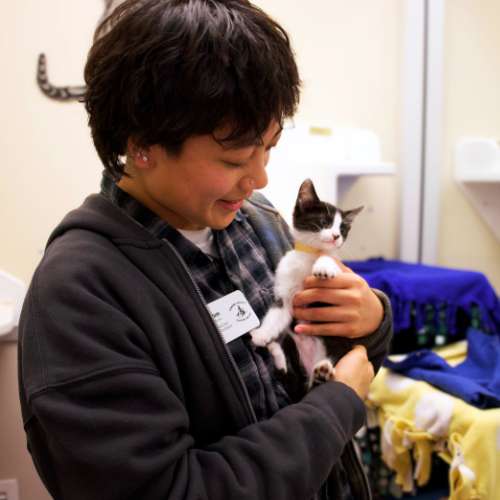
Limited access to certification programs makes this harder on everyone. Two or three years ago, HSSV had to send people to classes as far away as Marin County, where instructors trained staff from many organizations at once. HSSV could certify about three people a year, limiting the number of families we could help and providing little relief for the technicians doing the work.
Today, about 20 HSSV staff are certified. More people means less of “the emotional and physical toll” falls on the handful who were certified first, Pam says. “Now that a lot of the new ACE staff are certified, it lessens the load on the people that have been doing it for so long.”
To build on that, HSSV is developing a euthanasia certification program for our staff and other shelter professionals. The need is bigger than HSSV. By An’s count, only two or three instructors are left in California who can teach the course, and they’re trying to retire. “The goal is to make sure that we have enough to provide the service,” An says. By offering more training opportunities, HSSV can help keep compassionate end-of-life care accessible to families and ensure more shelters have the skilled staff to provide it.
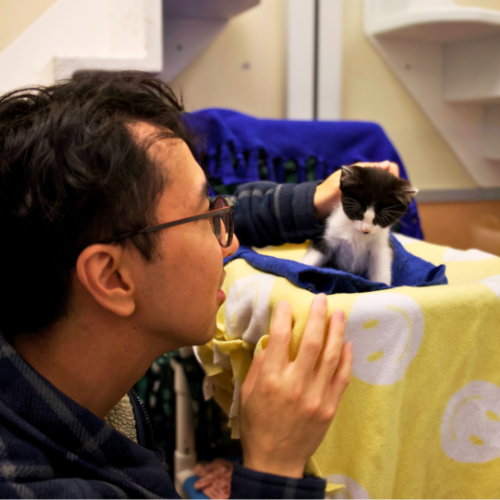 It’s a lot to boil down into a lesson plan. But it’s Scott’s job now to try.
There are some things that are harder to teach. Scott can explain what will happen in the room. Staying steady while a family falls apart in front of you takes longer. “Keeping your composure when everybody else is losing it in the room,” he says, “it’s a hard skill to learn.” He won’t call Elliott or Pam “fearless,” he says, “because there’s always nerves.” What he sees in both of them is composure.
Can you teach compassion?
An thinks so, though it never looks quite the same twice. “Some people naturally lean into the more huggy side, the more warm side. That’s me,” he says. Others lean on information, because some families feel most supported when they understand exactly what’s happening.
Elliott and Pam both say the real lessons came from being in the room. “Most of what I learned occurred during my time as handler for Scott,” Elliott says. Without experiencing it firsthand, “it is difficult to grasp what’s needed to best serve our clients.” For Pam, being there taught her to “read the room,” because no two goodbyes are alike. “Some people read letters or sing songs to their animals,” she says. “Some like to play music from their culture.” Her goal is for every family to feel “comfortable, seen, heard, and reassured during such a difficult time.”
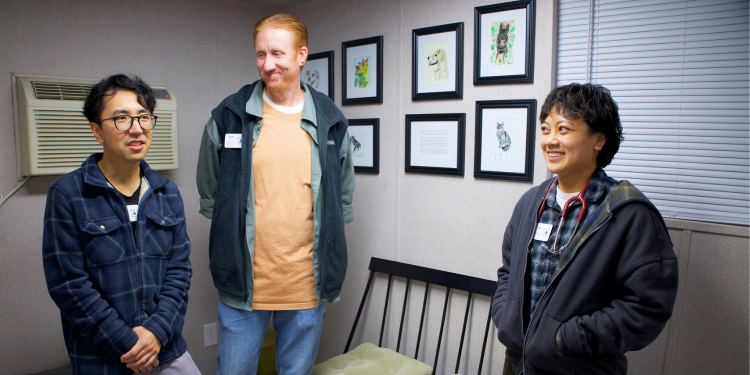
If compassion can be taught, it happens in the room, next to someone who has done it before.
Someone has to look after the people in that room, too. “We’re often asked, ‘How do we do this all the time?’” Elliott says. “While we all sincerely appreciate the sympathy, and yes, it takes a toll on us as well, we understand that our grief pales in comparison to what families have to go through.”
While Elliott’s focus is on the families he helps, An doesn’t forget to pay attention to the toll it takes on his team. When thinking about what it takes to do this job, An says there’s the skill and the care for families, and then there’s caring for the technicians themselves. He says the latter is “the most forgotten.” The ACE team is a compassionate bunch, in his words: “you never really see them sitting down.” Taking care of each other means speaking up. “I think it’s asking for help. I think it’s being vocal.”
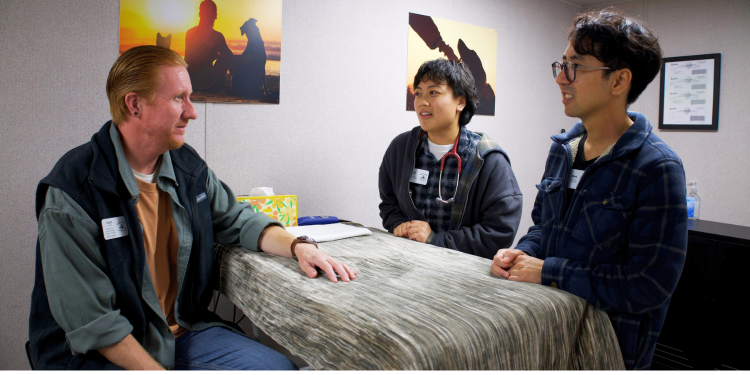
Pam’s advice for anyone about to start the training is to go easy on themselves. “There will be times when you stumble on your words or you get nervous and your hands get shaky, but that is all part of the process of learning and becoming more confident in your skill,” she says. “It’s okay to feel emotional; we are human.”
“Remember that every animal and family is different,” she says, “and the end goal is to make sure everyone is safe and supported as much as we can.”
This Shelter Appreciation Week, An has a suggestion for anyone who wants to support the team. “The first thing that comes to mind is thank you.”
Learn more about compassionate end-of-life support at HSSV here.