Finn found animal welfare because she missed a college deadline. Ellie found it on Sunday visits to HSSV with her dad. For Shelter Appreciation Week, two members of our team share how they got here, and what keeps them going on the hard days.
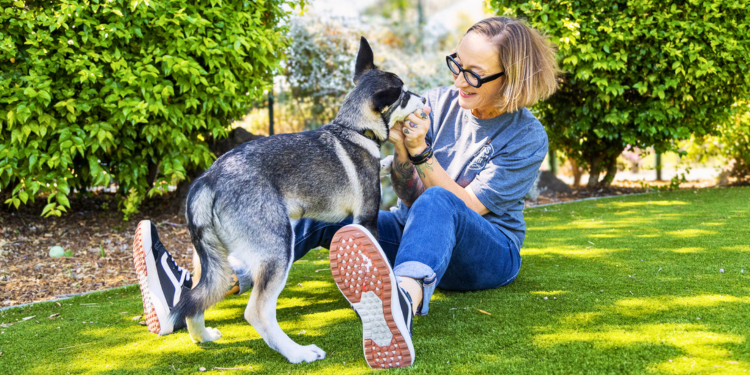
When Finn Dowling was a kid, her best friend was Hoover, a small Pekingese from the shelter. Her father, an FBI agent, named the dog after J. Edgar.
Big dogs were another story. The collie next door scared her so much that she waited for the school bus up in a tulip tree.
That might surprise anyone who knows Finn today as a tireless advocate for all dogs, even – or especially – the “scary” ones.
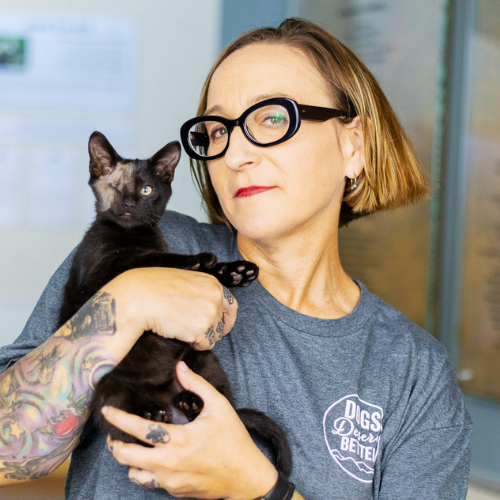
Finn’s career started with a missed deadline. At The Evergreen State College in Washington, first-year students owed a set number of community service hours every week, and Finn skipped hers. Late in her second semester, her advisor told her she had a few weeks to make up roughly 180 hours. She called around. Every organization turned down an untrained volunteer except the animal shelter.
“I just fell in love with it,” she says. “I found my people. I found my calling. I found everything.”
What drew her in was the staff, people doing hard work “out of such deep love.”
“I just saw so much bravery and resilience and dedication and commitment in them,” she says, “that I wanted to be like that.”
Finn very much became like that.
There was no turning back for Finn – animal welfare was her calling. Through college and for years after, she worked at that same shelter, first as an intern and later as an animal control officer. She wrote and voiced its flea-control radio ads as Freddie the Talking Flea. Wherever she moved after that, she took a job at the local shelter, including in Florida and Colorado. She deployed with a disaster response team after Hurricanes Charley and Katrina.
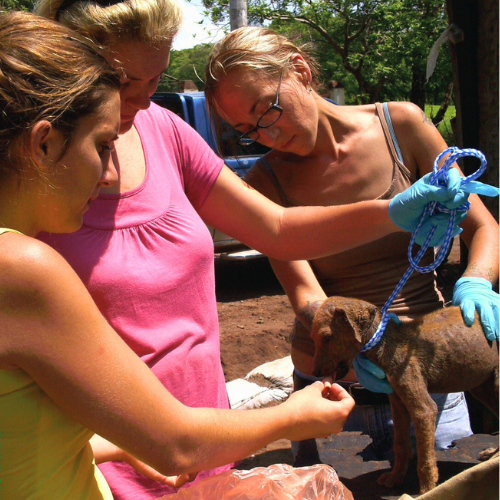
Finn working with two nurses outside of Granada, Nicaragu, on a joint project to deal with scabies and other zoonotic illnesses.
As much as she loved it, as much as she knew she found her people and meaning in the work, it was grueling. Burnout is a common affliction in shelter workers – to understand why, just ask your local shelter staff what they experience on a daily basis. Finn suffered from burnout just like anyone else.
Twice, the work wore her down enough that she stepped away. The first time, she spent five years at Kong, the dog toy company. When she wanted back in, she heard about people starting a shelter in Granada, Nicaragua. They couldn’t pay her, but they could cover her housing, so she sold her car and stayed a couple of years.
“It completely revitalized me,” she says.
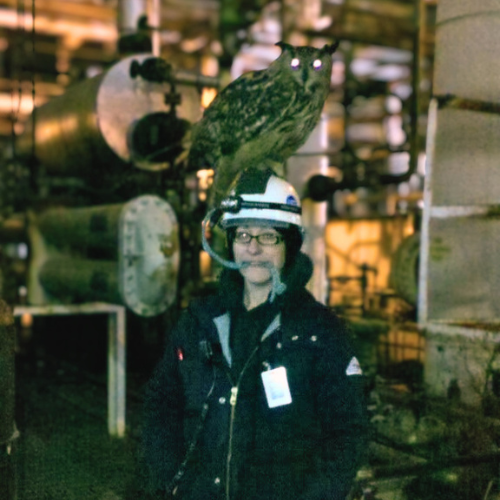
Working as an owl master
The second time, she spent winter nights as the owl master for an industrial falconer, climbing scaffolding to place the birds. In the off-season she took a part-time job at HSSV’s front desk, in adoptions and intake.
On slow days, she started writing for HSSV’s blog. Carol Novello, then HSSV’s president, read Finn’s post about two nuns who adopted a dying cat, walked out to the front desk and asked, “Did you write that?” Finn had studied journalism. She knew how to spin a yarn. Carol moved her into marketing, where Finn wrote the listing for Eddie the Terrible, a Chihuahua whose post gave three reasons not to adopt him. It went viral and won HSSV a Shorty Award.
Today Finn is HSSV’s shelter engagement manager, and her work reaches shelters across the country and beyond. One project she’s especially passionate about is a free library of more than 50 Spanish-language handouts on pet health, behavior, and care. She wrote them at an eighth-grade reading level with input from veterinarians and behaviorists, and Daniel, a translator from Mexico, put them into Spanish. Animal control officers carry the link on their keychains. On a call with a Spanish speaker, an officer will ask for the person’s phone, pull up the right handout and hand it back.
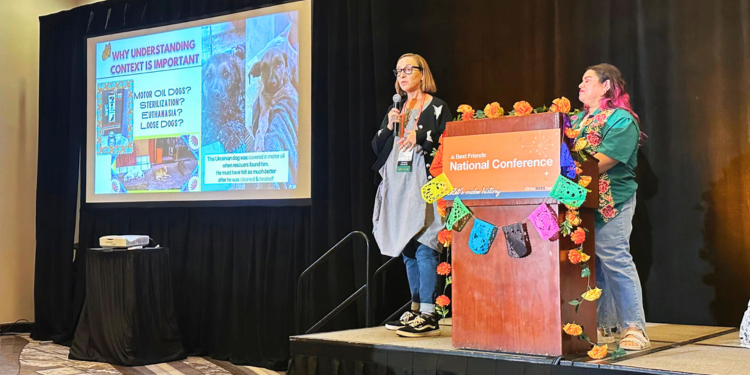
Presenting with Jakie Hernandez at Best Friends on language and cultural accessibility
“I’ll always be in the game,” she says. “I like to learn.”
Her passions, she says, have always been frontline shelter workers and the animals. She has adopted a custom from Mexico called las manos llenas, or full hands. “You always arrive with something, be it resources, an ear to listen, or just respect,” she says. “People don’t want a pizza party. They want to be treated like a human being.”
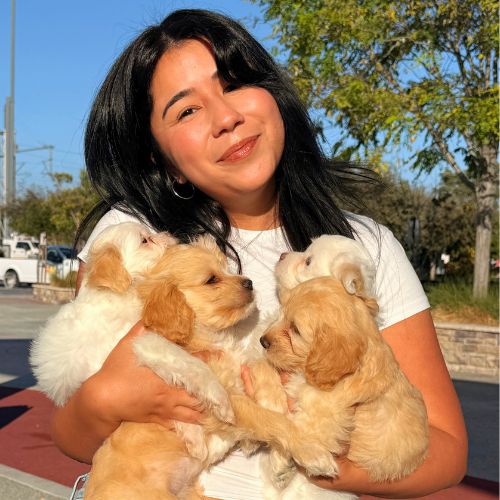
Ellie working at a mobile clinic
At HSSV, one of those frontline workers is Ellie.
Ellie works in Community Services, the team that answers HSSV’s phones and greets visitors in the lobby. She grew up coming here. Her family didn’t have a pet, so her dad would bring her and her sister to the shelter on Sundays to see the animals. Ellie liked to read the signs displayed throughout the building, like the one by cat adoptions explaining feline body language.
“I think visiting really impacted me, seeing how many animals needed homes,” she says.
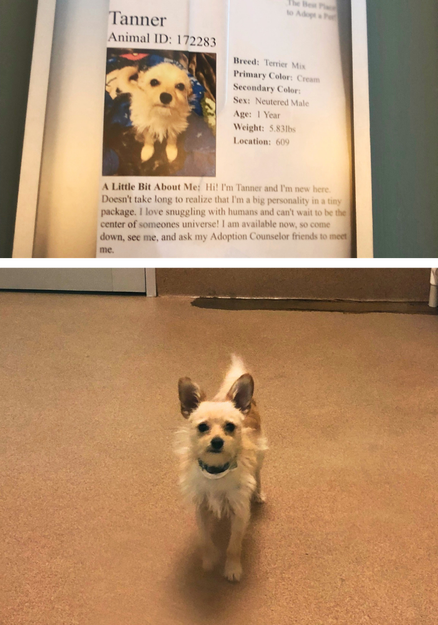
Jaxon in his adoption room at HSSV, waiting for Ellie to find him.
When Ellie turned 18, she was going through a difficult period in her life and made an impulsive decision: “I’m going to freaking adopt!” As she walked the adoption floor, a cream-colored terrier mix caught her eye.
She asked to meet him in his adoption room, and staff told her to sit on the floor because he was so shy. The dog ran straight into Ellie’s lap.
“I wanted to cry in that moment,” she says. “I knew he was the one.”
She had come in to adopt a puppy for something easy. She left with a one-year-old who was covered in scars, weighed just over five pounds, and had kennel cough. “None of that mattered,” Ellie says. Her sister paid the adoption fee, and Ellie spent every dollar she owned on a collar, a leash, and a little lamb toy. She named him Jaxon.
If you’ve read Finn’s post on Eddie the Terrible, you might’ve been left wondering, Who would want to adopt such a problem child? The answer, it turns out: someone like Ellie.
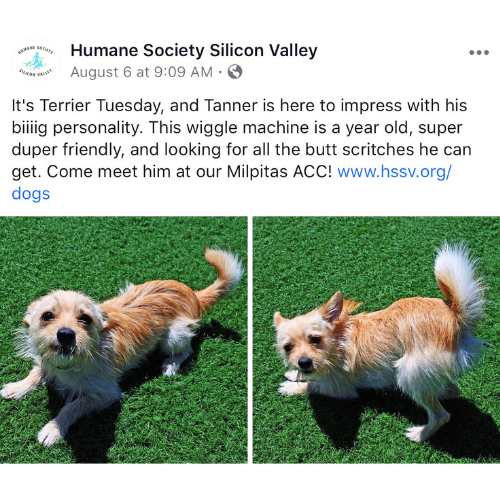
The post introducing Ellie to her soul dog.
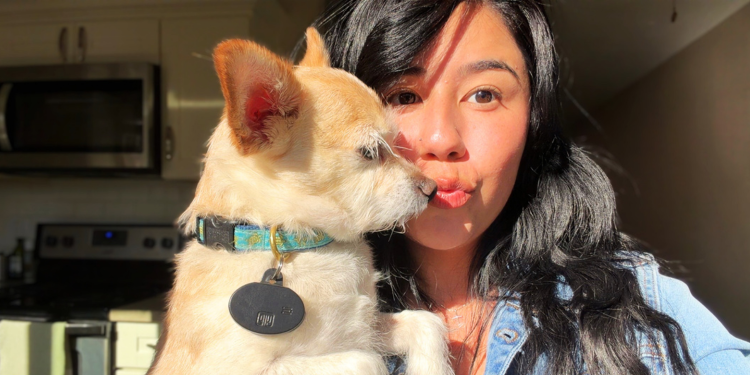
She calls Jaxon “a really bad dog” with profound affection. She explains: He barks at everything, he’s reactive so she’s careful where she walks him, he startles easily, he has severe stranger danger. It doesn’t matter. “I adjust my life for him,” Ellie says. “He’s my sidekick, my other half, and my soul dog.” She has three tattoos of him, and she walks past his old room all the time.
After high school, Ellie worked at dog hotels for a couple of years. Then she earned a degree in child development and taught for three or four years, including at the elementary school she had attended. She fostered animals while she taught, and people were always turning to her for help with their pets. She always felt she needed to do more.
There’s a conviction Ellie holds, borrowed from a book she read as a kid: “Be the voice for those who have no voice.” It’s this idea that motivates her to advocate for animals. “That’s my job. That’s my passion.” That’s how she made her way to HSSV.
Now she’s often the first person a visitor talks to. “I try my hardest to hear them out and understand where they are coming from,” she says. She keeps up with the latest resources, so she always has a way to guide people and a next step to offer.
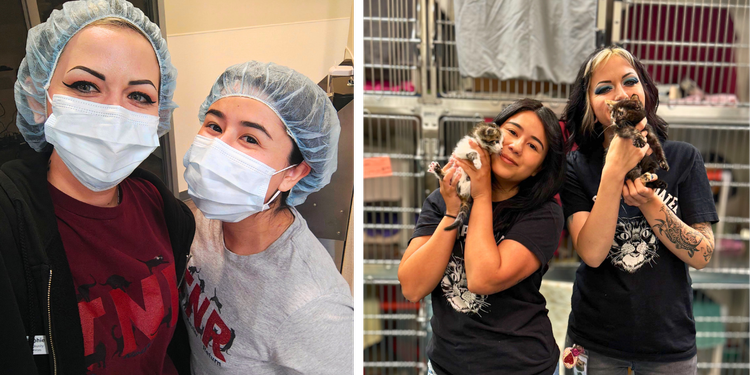
Ellie and Sophie, dynamic duo
One of her favorite parts of the job is booking spay/neuter appointments and helping people sign their pets up for surgery at mobile clinics. “A good day is everyone showing up for their appointments,” she says. “I love to see the numbers at the end of the day, and seeing how many lives we change.” She has a lot to say about why people should spay and neuter their pets.
A lot of her “free time” goes to trap-neuter-return. She’s been trapping community cats with Sophie, HSSV’s
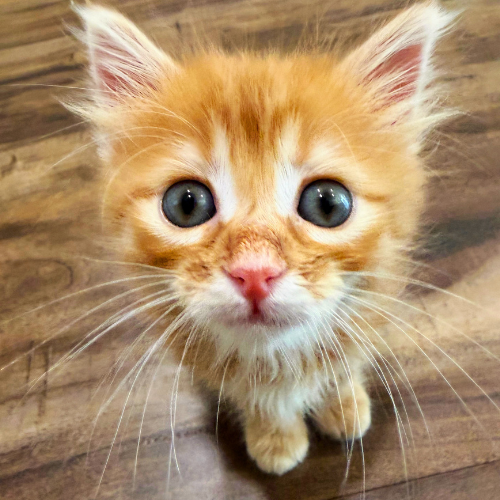
Butters!
TNR specialist, at one particular site the past few months. The workers there greet her the same way on every
visit: “Did you get a cat?” Some have confessed to crying over the stories she tells them about how the cats are doing.
Ellie is quick to credit Sophie for these updates. “She was the reason why we gave most of them a second chance,” Ellie says.
And she still fosters. This summer, at the height of kitten season, an orange kitten arrived in a diaper box. Ellie took him home to bottle-feed him for three weeks and foster for two weeks. Sophie took over fostering for another five. Butters was adopted in late October, the same day he was deemed ready to place on the adoption floor.
When Finn describes what drew her to a lifetime of commitment to shelter animals, she says she found “her people” here. Ellie did too.
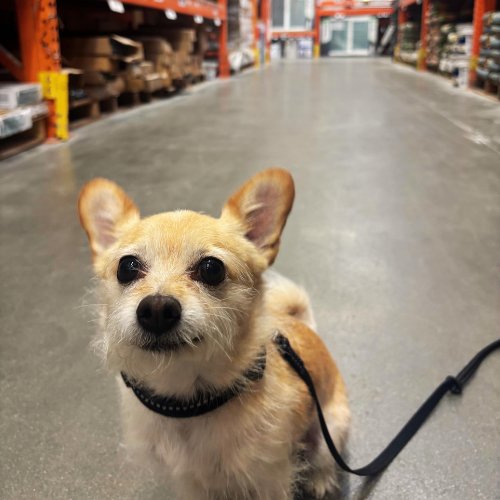
Jaxon says “thanks for reading this far”
“I truly feel you meet your people advocating for things that matter,” she answers. “Sophie is my person for sure.” And so are the people she helps run mobile clinics: Tschudy, Dr. Sanders, Dr. Witting. “I turn to them all the time when I am having a hard time,” she says, “and they always guide me back to my positive energy.”
It’s a good thing she has her people. That positive energy isn’t always easy to access, and Ellie doesn’t pretend any of it is easy. But she can’t see herself giving up. “I feel like I’m such a burning fire,” she says. “I’m just gonna keep going.”